Cultural Resources Survey of Four Disposal Areas
This field where we settled over 20 years ago never seemed physically special but there was a presence here. It's a leached sweet potato field out in the center of the open prairie, near the oxbow woods as I called them. It was not on the bayou. There was no important earth works, inclines or mounds as there are in other places in the prairie. The neighbors have found buckets full of artifacts: spear points, grind stones and stone tools. I know of the three prehistoric sites in the prairie including the Meche-Wilkes Mound and the Olivier site, but they are a half mile away from here. For years I have walked looking at the ground and feeling the subtle undulations, but never suspecting that there had ever been anything here besides farmland and pasture.
I had found ceramics. Years ago we surmised they were spread to aerate the soil for farming. Maybe they were spread in a flood event. Either seemed plausible. Maybe more plausible than there being a homestead in the exact spot that we chose, ten acres back off a gravel road, near haphazardly and only because of its proximity to a lone cypress in the tree line.
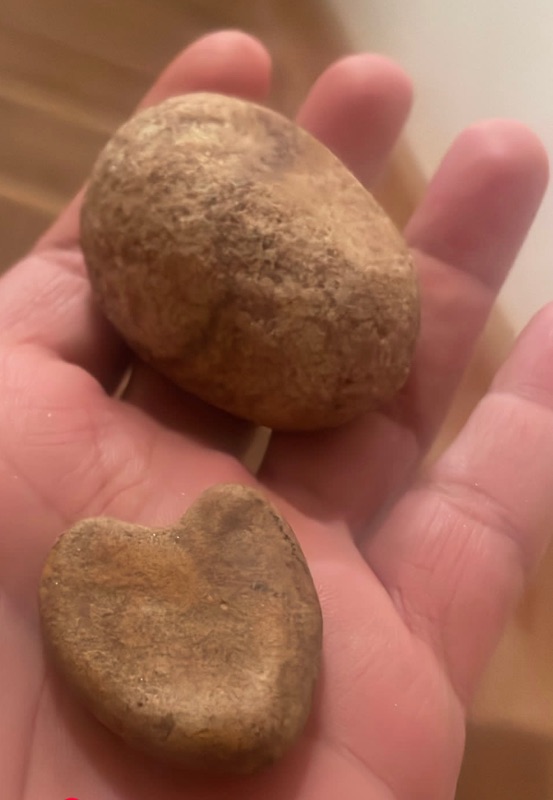
I found delicate things in the earth though, the curl of a blue and white fleur de lis, doll arms and legs, pieces of plates, bricks, thick crocks and milk glass. Still, with our position back here I could hardly imagine there had been habitation so far off of the dirt road. There were no paths or racourcis that I knew of crossing the prairie. Still I got the message that there was memory back here, both recent and ancient. Then one day in the carrot patch I found a real rock in the shape of a perfect heart.
In the east yard we plowed some rows to plant coton jaune, native brown cotton. After it rained I would inspect the exposed ground along the rows. I found another stone, but this time it seemed to be a hand tool for grinding or hitting. There was a worn tip and slight indentions along the sides that fit my thumb and fingers perfectly. I marveled at its weight and ergonomic feeling in my hand.

Sometimes when I walk the field, or even recently when I turned over a little dirt out there, I still find white ceramics and strange rocks, sometimes blue glass that looks knapped at the edges. The more I let the prairie grow, the more old plants appear that tell of use. The more I dig, the more is unearthed. I tell myself if there was a home place here it would have been in my east back field according to the evidence, but it still doesn't make sense. Not to mention how ironic it would be to have built in the same place. On the other hand, it does makes sense to me, because there is a tangible presence back here that is pleased to be remembered.
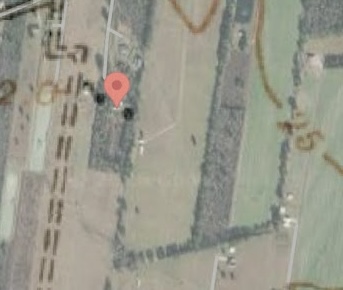
Recently I was going through some old topography maps online of the area and something caught my eye: a few black squares denoting domicile on the 1940 topographic map, far back in the prairie. Intrigued, I doubted it was far enough to be my field. But I used the overlay tool to match up the road and other landmarks with satellite maps, and discovered to my surprise that they were located at the end of my driveway, flanking both sides of my house, in the exact place where I find the ceramics in the backfield.

The prairie has a memory and it echos like a dome. I first felt it when I was alone out here at night, in a pull camper, waiting. I'd sit at the table, the light from the sliding glass door created a halo of illumination that terminated at the long grass, where I perceived its rustling as large animals passing in the darkness.
The pre-Katrina nights out here I was afraid of the wilderness of this place. It was the camp. I was never sure how near or far I was from civilization. I stayed quietly in the camper, barely wanting to alert the prairie of my presence. But the Tuesday New Orleans flooded, like so many others, I fled north and took refuge in the prairie like no other place before. The long gravel road was my moat, the orb of light in the field around the camper became my world, the safest place in south Louisiana.
We planted the prairie edge with a ring of thousands of native trees: sweet gum, live oak, cypress, persimmon, pecan, mulberry etc., keeping the center pasture open in different rotations. The trees created a little wood where we maintained a path, and formed a semi-circle around the perimeter of the property. The higher the edge trees grew, the more my prairie view was obstructed, but also the more the birdsong echoed within the dome of the prairie. I sat at the base of the cypress tree and imagined the life I would lead here. Somewhere, floating in the air above the prairie ground were the rooms of a castle-home not yet built, where I would live blissfully, conceive and become a mother, raise my children, where I would birth this very blog and all of the notions in it, where I would deny myself the world for the protection of the prairie.
I became one with this place, instinctually returning all fertility to her ground. It's here where my children's nombrils are buried, under a live oak in the western yard. I ate the flowers and fruits and roots produced here. I gathered and made medicines daily. I made perfume oils and sprays of the prairie flowers and balms with the pine sap. I caught rainwater and collected dew on resonant days. In the late afternoons in fall, I could hear a faint rumble, like thunder, of the Beau Chene drum line echoing in the dome. The prairie remembered drums.
I settled into the natural law of this land. We grew and lost both plants and animals without getting too sentimental. We allowed nature to rule, even a little wildly. Out of this natural kingdom many realms were born in me. We planted gardens but I never had a green thumb. It was the native plants that resonated because they were not reliant on me, except for my understanding of them and their environment and my dedication to their growth and protection. As time when on plants like honeysuckle, chassepareille, elderflower and blackberry crowded themselves through every crack of the fence, waving wildly to be noticed, to be made of use, and I listened.
There was an unassuming charm here at prairie, an enchanted, forgotten country east of Opelousas. It was in the juxtaposition of her beauty and humility, of how she is treated now, and the dignity in the story of who she was before. She remembered the millennia of seasons, and despite the modern agriculture, the cutting and poisoning and the forgetting of the old ways and the old languages, the plants remembered the cycles and seeds still remained in the ground who, despite the loss of so much rhizome, also remembered how to grow, especially after a prairie burn.
There was information in the silence and the space that I lived in, the movements of the plants and animals, the sunrises and sunsets, the position the moon rose at different phases adn in relation to the cypress tree. Sometimes when the prairie sky domed around the edge trees I could feel the different birdsongs that echoed within this protectorate. Slowly I learned that language, too.
![]() |
| My red ballet flats with prairie dirt in the camper, 2004 |
![]() |
| Decorations of dog fennel and a bottle of red liquid we found in the house, room party 2004 |
![]() |
| Me and Paul in the orb, 2005 |
A swamp rose out the darkness
Coton jaune from the loom
Sillage on my homespun
Of Indian perfume
The marsh was wide at midnight
A braid of long black hair
The feather of a water bird
The sacred vinéraire
I gathered my best medicine:
Dew from the swamp rose bloom
The highway cut straight through the marsh
Love is like a wound
I gave him my best medicine
Under the flower moon
A bouquet of everlasting
He called Indian perfume

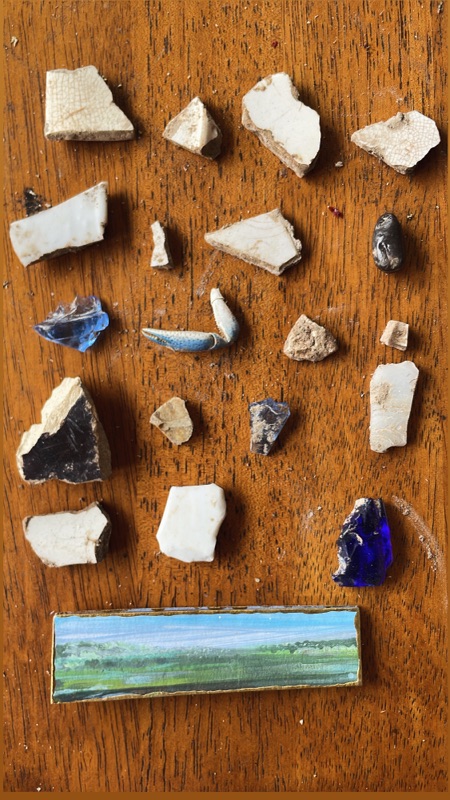
Various white and black glazed ceramic
Knapped blue glass
Blue crawfish claw
Heavy polished black stone
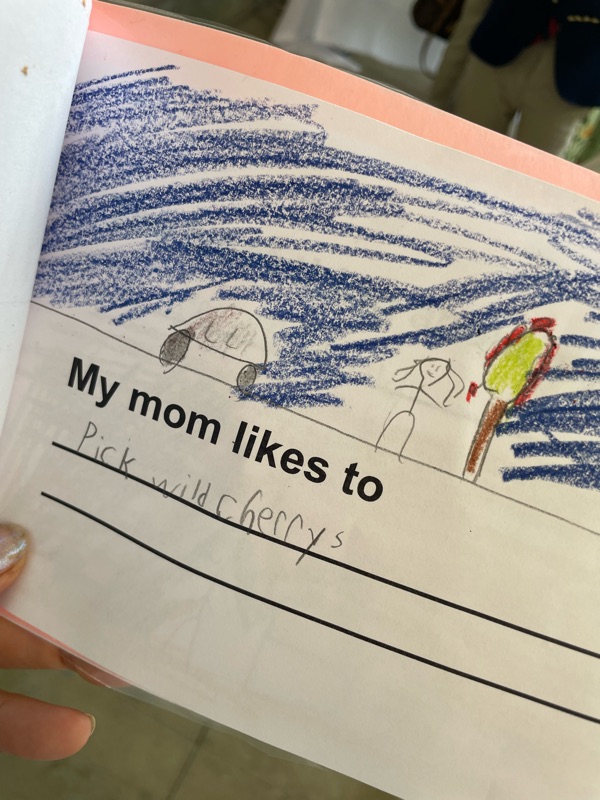
I went and picked cherries on the tree line. I saw a mockingbird in the cherry tree and we exchanged some unpleasantries. There are three cherry trees in the Sacred Heart tree lines that I know, and they are growing among fragrant cherry laurels, chasseparaille, wild grape vines, pecans, hackberry, and elderflower bushes. Today there was a light drizzle paired with the smell of bonfire out on the blue coteau. There were nettles gone to seed underfoot with no sting. I picked cherries until it started to really rain. I stored them in an empty plastic apple I got for teacher appreciation.
I gathered there, at home and also along the Bayou Fuselier Road. I reviewed the name of wild cherry in Choctaw italikchi, doctor tree. Tomorrow I plan on checking my other trees and researching the uses of the cherry leaves, bark and root after Marius' first communion.


Ashlee Eastin Wilson is an artist, musician, writer, Cajun radio announcer and teacher from Ville Platte, Louisiana. She is an autodidact in Louisiana (Cajun/Creole) French and is known for her documentation of the folklore of her native Evangeline Parish and the locale Prairie des Femmes in Saint Landry Parish where she lives.
Ashlee Wilson was raised in Ville Platte, Louisiana and graduated from the University of Louisiana at Lafayette in Secondary English Education. An anglophone by birth, she became fluent in French by attending University Saint Anne in Nova Scotia. She taught English literature and French for over a decade in the Louisiana public school system, namely Beau Chêne High School and the Academy of the Sacred Heart at Grand Coteau. With grants procured by her French student’s work, she was able to furnish her classroom with sets of the Dictionary of Louisiana French as well as other cultural titles.
Ashlee dedicated years to careful documentation of the radio program La Tasse de Café on 92.5 KVPI, transcribing stories, local folklore, word play and herbal remedies, as well as modern commercials and snippets of modern Louisiana French life. This work culminated with being hired by KVPI as the youngest female host to announce the news in French, the Tasse de Cafe Radio Program, and even hosting the world-famous Saturday morning French broadcast from Fred’s Lounge in Mamou. The written and recorded documentation from these years serves as the source for her current work in self-taught folklore. Additionally this work prepared her to act as the French announcer for “Bonjour, Louisiane” a morning French music and news program at KRVS in Lafayette, Louisiana. She replaced the long-time host Pete Bergeron who initiated the program and held the position for 40 years.
She served on the board of directors for the Council for the Development of French in Louisiana (CODOFIL) from (2009-2012) and as a Louisiana ambassador to the Centre des Francophonie des Ameriques in Montreal in 2010.
In 2012 she began the Prairie des Femmes blog that became an early online resource for authentic information about Louisiana language and culture. The blog began as daily documentation of the place known in French as Prairie des Femmes (Women’s Prairie) and research on the origin of this place name. It grew to include photography, memes, writing, French transcriptions, recordings, folklore, music, lessons, and more. It was one of the first websites to offer visual media in Louisiana French and incorporate local folklore and music lyrics into modern media for a younger audience wishing to learn. Ashlee uses her knowledge of modern American culture and blends it organically with the archaic knowledge found in Louisiana French. She has served the community by providing bilingual announcements at the Lafayette Regional Airport, translating the Opelousas Travelers Guide to French, appearing on radio and podcasts such as Louisiane en Vers and Charrer Veiller, and by hosting the monthly French table in Opelousas as well as the Arnaudville French Table at Nunu's.
She is a diarist and draws endless inspiration from hundreds of handmade seasonal journals and books in Louisiana French she creates, as well as dozens of niche zines. She has published as a guest columnist in local papers such as the Advertiser, Advocate, The Current, Les Bonnes Nouvelles, New Orleans Magazine and Acadiana Profile. Her work has been featured in 64 Parishes, Bitter Southerner, Oxford American, Country Roads Magazine and the New York Times. She published her first work ‘Ô Malheureuse’ on UL Press in 2019, a first of its kind collection of modern Louisiana women’s writings in French. The collection began on the PDF blog and was published by UL Press and released in time for the 2019 Festival Acadiens and Creole dedicated to the contributions of women in Louisiana music.
As a photographer, Ashlee has self published three books, The Plains of Mary, a photo book of Marian yard shrines, Prairie des Femmes: Portraits of a Place, a collection of surreal photographs from the countryside of Acadiana, and finally A Prairie des Femmes Field Guide, a collection of art and writing from the PDF blog. Her work has been featured in Louisiana Cultural Vistas, 64 Parishes, and she has shown her photographs with photographers Denny Culbert and Jo Vidrine. She had thirty of her photos shown as part of Frank Relle’s New Orleans in Photographs exhibit in Moscow in 2014. Her work has also been recognized by photographer Zack Smith’s project « My Louisiana Muse » as well as Nick Slie’s « Cry You One. » In June 2024 her land work, as well as her work with the rare medicinal plant vinéraire was featured in Monique Verdin and Rachel Breunlin's Botanica exhibit at the Cabildo in New Orleans.
Her family and home were featured in the Home and Garden Section of the New York Times in 2012. As recently as 2021 her work was featured by National Geographic and in a documentary that won the CreateLouisiana culture grant, Intention, by Olivia Perillo and Syd Horn. It is a film project that seeks to explore the untold feminine narratives of Cajun and Creole artists and healers.
She is a musician, well known in south Louisiana as a professional triangle player. She also sings and writes in Louisiana French, incorporating modern music with that from the Cajun and Creole archives. Her first original song ‘Maison Blanche’ released on The 78 Project in 2014, and in 2020 Nouveau Electric Records released her ‘Trois Rangs’ on 45rpm vinyl, remixed by Korey Richey (LCD Soundsystem). She has played triangle on the recent PBS documentary American Epic.
In 2024 Ashlee's work for the Prairie des Femmes was included in the exhibition Botanica at the Louisiana State Museum at the Cabildo in New Orleans. In 2025 she showed her paintings, journals and plant research with the medicinal known as vinéraire in Prairie Stories, a collaborative show at the Acadiana Center of the Arts in Lafayette, Louisiana. Prairie Stories featured a collection of artists and their work on the folkloric and environmental realms of the Louisiana Prairie. She has spoken at the Louisiana Folklore Society meeting on the Prairie des Femmes Blog and digital folklore, as well as at the Bayou Culture Collaborative meeting where she spoke on her ethnobotany research. Most recently in May 2026 she presented in the Folklife Village's Past to Pixel tent which featured digital folklore
at the New Orleans' Jazz fest.
As of 2023 Ashlee is the lower school French teacher at the Academy of the Sacred Heart in Grand Coteau, Louisiana. In August 2024, she began leading the Arnaudville French Table at Nunu's Cultural Center.
Ashlee raises her sons in the Prairie des Femmes.
When I was a girl I read in a Susan Branch book about the folkloric belief in the healing and beautifying powers imbued in the dew of May 1st. Since then it's been thirty years, and I have made a point to celebrate May 1st by touching the dew, gathering flowers, crowning Mary and eventually collecting ounces of dew in bottles and pyrex measuring cups.
Images from my Instagram Memory entitled "May 1"
Vale Rosa Palustris
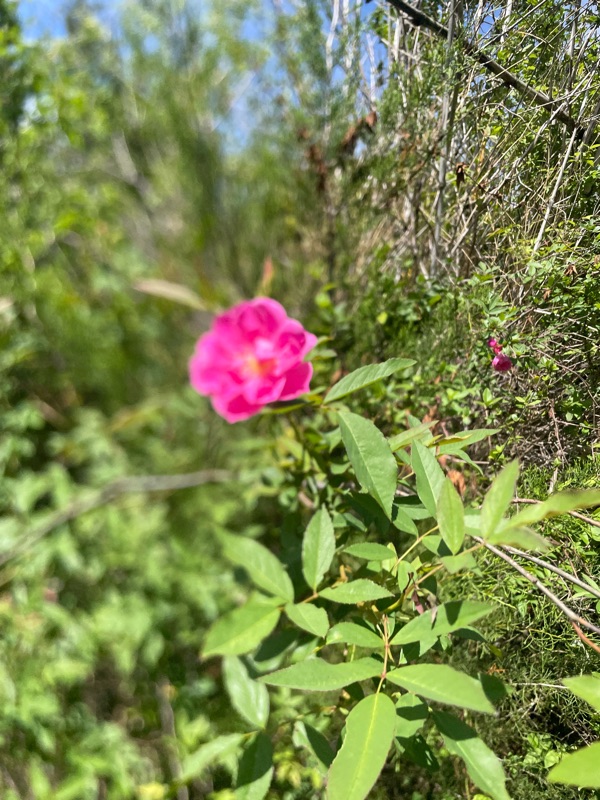
Swamp Rose season comes with the arrival of the painted bunting's persistent song, blue cardinal eggs in the blackberry bush, red Mamou flower shoots, mulberry trees in full fruit. Both the male and female cardinals tend the nest. The mama bird is so intelligent. She has made her nest in a little Celeste fig tree overtaken by blackberry vines. Within the protection of the blackberry bush’s thorny cage, all surrounded with red and green fruit, her nest is suspended. It is next to a blue kiddie pool of fresh water and a few feet from a mulberry tree in full ripeness. There was a big storm from the west last night and the sound of the rain on the metal roof woke me up at midnight and just before sunrise. I wondered how the mama cardinal protected her three baby birds, and imagined she did so with her wings. The rain turned the nasturtium yellow. I repotted it. I am tending a small garden edged with unused firewood and filled with compost from the Saint Landry Parish landfill. There is a blue runner who visits the garden. Daily I check the cardinal nest and the swamp rose blossoms. Often I have to balance myself on an old bathtub covered in honeysuckle vines in the side yard to reach some of the roses before they fall. This year they traveled up the bamboo, so some blossoms are 15 feet up. Their scent is like baby powder, water, citrus, rose and pink pepper. The chirp of the cardinals and the song of the painted bunting always accompany my gathering. This morning there was a big swamp rabbit in the white clover I observed as I pulled out a loaf of bread I had risen all night from the oven. I'll have to leave prairie in a few days to go to New Orleans and reveal myself by speaking about Prairie des Femmes at the Jazz Fest folk like village. I'll miss the observation of the cardinals, the painted bunting's song, the gathering of the swamp roses and ceremonial dew on the morning of May first, as well as the ritual procession and May crowning of Mary at the Academy on the coteau. The girls will wear white and silently process to crown Mater with flowers. We present her with a bouquet of blue Louisiana irises at the grotto while we sing the Magnificat in rounds.


La pluie tombe sur ma reineaume
Mes larmes font une prairie tremblante
La terre ondule en bas de mes pieds
Je suis la Prairie des Femmes
Rocky McKeon created the bilingual gossip column Le Tabloid Cadien! and multiple YouTube series as well as Cajun rap mixtapes and rock music content in the late 2000s. Evangeline Parish alone had Lucius Fontenot's Pointe Aux Pins site and Mike Hebert's Cajun-Creole blogspot as well as the L'Anse Grise Forum that was active with Dowell Lafleur as chef-en-tête. There was an early Facebook page called "Mais get down and save the dishes next to the ice-box, yeah." After characters like Nonc Chauz and Poo-Poo Broussard went "viral" the Cajun influencing began.
This here PDF blogspot began humbly in 2012 to provide a real, albeit liminal, perspective on Louisiana Cajun and Creole culture. It was shown through the eyes of a self-taught Louisiana French speaking woman who found herself in an old place that was still largely wilderness. I am talking both metaphorically and about the physical realm. The linguistic as well as geographic isolation, coupled with learning my heritage language, doing my genealogy, becoming a mother, observing the seasons and plants and animals was all enriching as well as overwhelming. I was inspired by the language, the place names, the folklore of Louisiana, and wanted to provide something new and more substantial than the usual cliché versions of our culture found in the media and popular culture. I didn’t want to feed into those ideas, but to provide a real look into the values of a modern Louisiana French woman. I used it as an excuse to explore my own linguistic acquisition, creative whims, as well as document the place where I lived. From the surface the prairie seemed like any Louisiana back country, east of Opelousas, but deeply held the old memory that only the earth can keep.
I hazarded myself to my elders, accepting their corrections, guidance, and stern warnings against some behaviors. I saw, and still see, my role as someone who gathers, protects, expands not just the folklore and language but also the values carried in it, the old Latin ways and Indigenous matriarchy that our great-grandparents operated within, maybe even without realizing it. I wanted to share my experience learning the language to provide an example of what is possible for other young people as well as what healing can be done inter-generationally across the reacquisition of our heritage languages, and applied this to my artistic work. It was healing work of my own linguistic wounds as well as those of my community and for years I did it anonymously, with no name attached to my blog. This was my deeply painful and complicated identity work that comes with the responsibility of true language acquisition, and I wanted to be a vessel for it, to transmit it. If you know anything about treatment, faith healing and the beliefs that we still carry, you know this work intrinsically carries a prohibition against capitalizing upon them and even speaking of the work, if the healing is going to happen at all. Otherwise, it’s just American business as usual. This has been my struggle and I still reap little to no financial benefits from my herbal, language or artwork because of my core belief that it may negate the healing. Like saying thank you for a plant, or working on Good Friday. There are certain things we just don’t do.
Fast forward 20 years and there are a whole crop of “Cajun influencers” Some of them are credible and show an authenticity, have a true feeling of humor and gentility about their approach. They enrich the culture by their contributions and transparency. There are some who, despite their heavy accents and adorable mannerisms, many of which hit us in the nostalgia, still miss the mark.
It's important to honor that we all contribute in different ways according to our strengths and expertise. Some carry the culinary traditions, writing, hunting, fishing, trapping, woodwork, music, instrument making, joke and storytelling, crawfishing, foraging, song, dance, horsemanship, rice farming, trail-riding, mardi-grasing, quilting and tatting, embroidery, basket weaving, language reacquisition, traitment. Many of us carry multiple of these and others. We must take these responsibilities seriously. We allow ourselves to creatively innovate and improvise within ourselves and our modern community values without selling out our ancestors. It is our job to steward the language and culture mindfully across our generation. Cultural work after greater community loss is deeply personal work within the individual that also that spills out into the larger society. If we share it without true understanding and measure, it risks the continuation of Cajun stereotypes, half truths and generalizations that we have endured for centuries, but this time it is metabolized, disseminated and sold out by our own people who think a quirky t-shirt, a seasoning blend and/or some catch phrases is proof of culture deep enough to influence. I fear that Americanization has already influenced the influencer to capitalize on our culture on a surface level to appeal to the general American public.
KW
Comment recommencer la mémoire? This work of figuring out who you are, who we are, how to reengage with the language and apply the values of our ancestors is not to be broadcast and cheapened. It’s personal work full of the missteps made by us, the perpetual children of this culture, who are just learning how to speak and move gracefully and with humility, as did our ancestors. If influencers did the private work, and learned the language, experienced the humility of the old ways, felt the embarrassment, ingested the same indignity shown to our elders through the language, they would cease to want to be influencers on an American platform. There is a change in the value system when we metabolize the true essence of our people and of Louisiana French and Creole, and this dignity has parameters, it is not a joke or entertainment. True stewardship of our culture is sometimes silent. It's like a prairie plant that blooms quietly in the pasture even in the face of subsidence and drought, poison and plow, unseen by anyone but the bees who work to pollinate the entire Cajun Prairie.