Saturday, June 29, 2013

To the Platin and back with the Milans

My Padna Mike Hebert dit Milan makes the most interesting videos of his parents Madame Calvelene and Monsieur Roland Hebert speaking French. Every word they say is pure Evangeline parish poetry. Merci Mike! Keep the videos coming. Check out his YouTube Channel for more videos like this one.


Allons 'oir icitte, Mike nous a donné un papier icitte avec des mots comment dire en français

Uh, j'étais soule hier au soir...Ça ça veut dire...I was drunk last night.
J'crois ça serais...eh? J'étais soule hier au soir...
Ouais lui il a écrit "Je m'ai saoulé hier au soir."  Which means, I got drunk last night.

Un autre mot c'est uh...
Beaucoup d'bière

Ouais, beaucoup de bière...a lot of beer.

Ouragan.  Ça c'est comme ouragon. That's Hurricane like Issac! Ouragon!

Uh, Ça c'est quelquechose ma grandmère disait quand on avait un ti bo-bo sur la main or quelquechose a disait "caca chat, caca chien, guérir quand tu pourras."  Ça, ça veut dire: Cat poo dog poo heal when you can!

Et un autre affaire c'est sureau petard pop-gun with china ball which was des boules de lilas!

Et icitte c'est, Donne-mon du pain d'maïs. Et c'est ça que j'suis juste fini de manger pour souper drêt... peut-être dix minutes passé. Du pain maïs. Give me some cornbread!

Et là c'est donne-mon une bonne bière fraide, s'il vous plaît. Give me a good cold beer please.

Et un autre mot c'est pigeon vole -- pigeon flies. On jouait ça quand on était petit, tu te rappelles?  Ouais quand on était malade on pouvait pas jouer dehors, ou c'était frais, ou c'était.. on peux pas aller dehors on jouait dans la maison, pigeon vole!

Et, orage de tonnerre and mauvais temps. Storms and bad weather. C'est là on peux jouer pigeon vole! That's when we played pigeon flies!

 Et les patates... blanquettes et.. comment tu dis ça, Dad? and oeufs battus! Blanquettes et des ouefs battus! ok, Moi, j'ai des misères à lire en français. Je peux parler en français mais, j'ai des misères à lire en français. Blankets (Smothered Potatos) and Beaten Eggs. I have trouble reading in French. I can talk in French, but I have trouble reading in French.

Ça c'est mure filante and mure d'éronce! dewberry and blackberry. Des bonnes affaires pour faire des tartes et des pâtés!

Bonjour! Comment les affaires à ce matin? Ça j'connais qui ça veux dire! Hello, how are things this morning?

Ouais, allons 'oir icitte ça dit c'est uh... la viande moulé ground meat...

Et là icitte dit...Sur le jour ma noce, ma mouman arête au Half Moon pour acheter une bouteille de champagne. Ouais c'était ma mouman. C'est...j'avais dis ça. Sur la route pour aller à ma noce, on avait arrêté au Half Moon à L'anse Grise pour acheter une bouteille de Champagne pour ma noce et j'restais assis dans char avec ma robe de noce. J'avais beaucoup honte! On my wedding day, my mother stopped at the Half Moon in Grey Cove to buy some champagne. I was sitting in the car in my wedding dress. I was embarrassed a lot!

Ben, uh, icitte c'est une journée on té là bas... au assister les fetraille? Monsieur Edius Naquin et Gussié a passé et arrêté et l'on dit à mon, il dit, quitte-moi 'oir ces tites... ces petites Milans! Ça c'est le nom la famille avait pour les années et des années passés. Et tu 'ois, Monsieur Edius usait juste ce nom: Milan. Edius Naquin and Gussie passed and said "Let me see those little Milans." He used Milan, which was the name our family had gone by for years and years passed... and he only used this name: Milan.

Je me réveillé de bon matin pour mon aller pecher à Miller's Lake mais il mouillait trop. I woke up early in the morning to go fishing at Miller's lake but it was raining too much.

Monsieur Fontenot, donne-mon un bout d'boudin. Ça tu 'ois, je peux lire ça! et là il dit qui d'autre? Mr. Weelo, give me a link of boudin. Gratons aussi? Droite là. Je vas donner ça...toi.


Allons parler pour les places:

 Le Platin (The Large Flat, Low Place)

Le Platin. Qui ti jongles quand on dit platin? Quand on dit platin je jongle à la cimetière. Presque-proche tout notre famille est enterré là.
Ouais un platin c'est une grand place avec la terre basse. Et la cimetière est dans cette place là.

L'Anse de Tate. (Cove of the Tates)

L'Anse de Tate c'est comme tu dis ça "Take Cove"! (Tate Cove)
Ça j'aurais pas compris ça: L'anse de Tate. Quand tu dis Tate je jongle à la tête, ma head!

L'Anse Cavalier. That's Horseman Cove.

L'Anse aux Pailles. (Cove of Straw)

J'avais jamais connu pour L'anse aux Pailles, mais, seulement quand les affaires est tonnable icitte on dit Allons à l'anse aux pailles! C'est parceque L'anse aux Pailles est si loin de L'Anse Grise, un grand bout, ça fait, quand tu jongle à un chose qu'est loin loin, tu jongles à L'anse aux Pailles.

 Pointe aux Pins. (Pine Point)

Ça c'est des arbres de pin, peut-être?
Ça ça veux dire, ouais, une place ayoù y'a une bandes des arbres de pin.

L'anse Aux Vaches. (Cow Cove)

Y'a un tas d'vaches, peut-être? Ouais, L'anse aux vaches, j'pense c'était une place ayoù y'en avait des vaches dans les autres fois, un tas des vaches, ils ont nommé ce place, L'anse aux vaches....

L'anse de Haïssable (Cove of the Hateful)

Ça c'est une place ayoù j'crois pas peut-être j'veux pas rester. C'est un drôle de nom, ça, L'anse de Haïssable.
Peut-être la terrte était pas bonne ou...J'pas comprendre qui ça veux dire, mais ils ont un place nommé comme ça. L'anse de Haïssable.


L'anse Bourbeuse. (Muddy Cove, birthplace of the Honorable Preston Aucoin)

Et là...beaucoup de boue? Ouais j'pense y'a pas beaucoup de bonne terre là, c'était trompe un tas. 'Pense c'était manière comme un platin.

Ok, Ça c'est tout!

Friday, June 21, 2013

The Interior Life of the Prairie des Femmes

I wanted the PDF to be my place of refuge as it had been for those women who were here. I wanted it to be an unexpected view. People always think they know what Louisiana is. I am from Louisiana and I don't even know what Louisiana is. She is a mystery and PDF and the origin story here captured that mystery. I wanted it to be a place of beauty and imperfection. I wanted to show the interior life, the little way, every little flower and thorn on the Prairie.

Monday, June 17, 2013

Saturday, June 15, 2013

Faubourg Guadalupe

Faubourg Guadalupe
Faubourg Guadalupe
beautiful cypress "grotto" with pink impatiens

Beautiful Mary with scallop detail


Our Lady of Grace- Faubourg
Statues from the beautiful homestead of Monsieur and Madame L. Fontenot,  photo submission by M.L.S.

Inquest Concerning George Stelly


INQUEST CONCERNING GEORGE STELLY WHO WAS FOUND HANGING FROM A TREE*


*This document written in French, was obtained from the Louisiana State Museum, New Orleans.


Submitted by Mrs. Roy H. Harper of Slidell, La. Translated by Michael J. Foret


At Opelousas, the twenty-fourth day of August of the year seventeen hundred ninety seven, we Don Martin Duralde, Captain of the militia and civil and military commandant of this post, on the verbal statement of Sieur Stelly and the written deposition of Sieur Robert Burleigh, syndic, that the above named George Stelly was found hanging from a tree and interred without the required preliminary inspection by the officers of justice, we went to Grand Coteau, where the incident took place.  In our presence and that of the witnesses, Sieur Charles Smith and Andre Meche, and after taking solemn oath before God, our lord, to tell the truth, and the Sign of the Cross we interrogated as follows:

First witness, Sieur Jacob Miller.
Question: Are you the grandfather of George Stelly?
Sieur Miller: I am.
Question: Did your grandson live at your house?
Sieur Miller: Yes, he lived with me for the past three months.
Question: Is it true that he was found hanged?
Sieur Miller: Yes, he was found hanging from a small tree.
Question. Did he have parents?
Sieur Miller: His father is dead, but his mother, still living, has remarried Sieur Joseph Frozard.
Question: Why did your grandson live with you and not with his parents?
Sieur Miller: He lived with me because he could not get along with his stepfather.
Question: Do you know the subject of their discord?
Sieur Miller: Someone told me that the discord came about because the boy wasn't dutiful, but, as for me, I have never found the child so; on the contrary, I found him submissive and respectful at all times.
Question: Do you know how this accident could have come about?
Sieur Miller: I do not know what reason could be behind this unfortunate occurrence.
Question: Did the boy have any enemy, secret or public?
Sieur Miller: I know of no such enemy.
Question: Did he have any differences with anybody prior to his death.
Sieur Miller: I am ignorant of any such differences.
Question: '"Who found the boy hanging?
Sieur Miller: The first to find the boy in this state was Jean Tyson.
Question: Why did no one call the authorities. Did not anyone know that in such cases one should not inter before this formality?
Sieur Miller: I do not know of any formalities involved in such cases. If I have committed any error, it was not because of any intent of mine or of anyone else's. I cried and cried as if I were the boy's father. Since be had been missing since the night before, and his body was already stiff, everyone agreed the best thing to do was to bury him but not before the body was viewed by the syndic of the neighborhood, Sieur Burleigh, and several other.
Question: Did you notice any contusions or marks of struggle?
Sieur Miller: I did not inspect the body because I was too overtaken by sorrow.  I heard other who had inspected the body, but no one said he saw any bruise or sign to induce such suspicion.
Question:  Did you suspect that anyone else hanged the boy?
Sieur Miller: I accuse nobody.
Question:  How is it possible that a boy of his age could have hanged himself?
Sieur Miller: I know nothing except that the boy was found hanging from a small tree with his shirt tied by its tails around his neck.
Question:  How is it possible that he had no contusions when a rumor has it that there was one at his waist and another on his eye?
Sieur Miller: I have not heard of there being anything else.  All I know is that the boy was hanging by a small rope, his feet touching the ground, his knife near him.
Question:  How old was George Stelly?
Sieur Miller: He was fifteen years old.
Question:  Is it true that relatives of the young man had family meeting to discuss what could happen to him and for what reason?
Sieur Miller: As a matter of fact, relatives had met to determine to whose home he should go since Sieur Frozard had said he would not serve as the boy's guardian. He had alleged that, far from being helpful, the boy mistreated and spoiled his brothers.  After that, the boy expressed a desire to come to live with me.  I swear by the oath I have taken that everything I have said is the pure truth.  I am about fifty-nine years old, roman Catholic and Apostolic, and native of Germany.  I have read my foregoing statement, and I declare that I have nothing to add or to withdraw from them.

[Signed] Jacob Miller

Witnesses:  Charles Smith, Andre Meche, Martin Duralde, Commandant

The same day, month, and year as the above and before us, commandant and witnesses, appeared Sr. Jean Tyson, who, after the solemn oath he took by the Sign of the Cross and God our Lord, to tell the truth, was questioned as follows:

Question:  Is it true that you found young George Stelly hanging from a tree?
Sieur Tyson: It is true.
Question:  How did this come about?
Sieur Tyson: The boy had disappeared since the night before.  His grandfather, Jacob Miller, sent his son to ask me to join in the search for the boy.  I found him hanging from the main branch of the tree, his feet touching the ground, his knees bent, his shirt off and tied around his neck by its tails and caught between his chest and the rope which served to strangle him.
Question:  What did you do after finding the boy?
Sieur Tyson: I did not touch him but immediately called those searching with me.
Question:  Why didn't you go to the authorities or advise notifying the authorities to inspect the body?
Sieur Tyson: None of us had ever been placed in such a position before.  We had no knowledge of the obligation to notify the authorities, but we did call in all other neighbors and Sieur Robert Burleigh, the neighborhood syndic.  As for the boy, we buried him at the place he was found.
Question:  did you or any others present notice any contusions on the body?
Sieur Tyson: The only sign I observed was a red eye.  Also, it looked as if the blood had been cut off from his feet or legs and from his hands and his arms.
Question:  Do you think the boy hanged himself?
Sieur Tyson: I think the boy hanged himself.
Question:  Do you know of any enemy the boy had or of any difficulty he had with anyone?
Sieur Tyson: I do not know of any enemy the boy had nor of any difficulty other than that he could not get along with his stepfather, Joseph Frozard.  Because of the difficulty the boy had lived with his grandfather, Jacob Miller, for the past three months.
Question:  Why could the boy not get along with his stepfather?
Sieur Tyson: The boy could not get along with his stepfather because he had a difficult character, given over sometime to fits.  He mistreated his brothers and sometimes wrongly advised them to contradict his stepfather.
Question:  Is it true that there had been a family meeting to discuss this discord and to decide on the boy's destination?
Sieur Tyson: Yes.  The relatives, who were numerous, met at the request of Sieur Frozard to discuss the subject of his malcontent, of which he [the boy] had contributed his part.  If the relatives found it acceptable, the boy would go to stay with his grandfather.
Question:  Do you know if the boy's stepfather or anyone else had threatened him?
Sieur Tyson: I do not know whether the boy had been threatened by his stepfather or by anyone else.
Question:  How old was George Stelly?
Sieur Tyson: He was about fifteen years old.
Question:  How do you think it possible a boy of this age could be driven to such an extremity?
Sieur Tyson: I find it surprising myself, but I know nothing more that could be of any help.
Question:  How can you say that you did not know of any obligation to notify authorities when, in truth, you had been warned of such obligation.
Sieur Tyson: It is true that Sieur Andre Meche warned that before touching the corpse authorities should be notified, but other persons said otherwise, since many years before an accident of another nature had taken place and no inquest had been made.  Furthermore, the body had begun to smell bad.  We thought the best thing to do was to bury him without any formality.
Question:  Can you say that the body did not bear any bruises when rumors say that there was one around the waist.
Sieur Tyson: I know absolutely nothing about any marks other than those of which I have spoken.
Question:  Who were the other witnesses to this affair?
Sieur Tyson: Others present that I remember were Andre Meche, Jean Savoie, Robert Burleigh, Periche Richard, Jean Tailor (Taylor), and Paul Boutin, fils.  I am about forty-five years old, Roman Catholic and Apostolic, and a native of Germany.  Everything I have said is the pure truth, according to the solemn oath I have spoken, and I have nothing to add or withdrawn from my statements.

(Signed) John Tyson

Witnesses:  Charles Smith, Andre Meche, Martin Duralde, Commandant

At Opelousas, the twenty-fourth day of October of the same year and for the same reasons as stated above appeared before us, the commandant and witnesses Sieur Jean Gradenigo and Sieur Augustin Grandenigo, Sr. - Sieur Jean Savoie, who after the solemn oath he took in the form required and conforming to the law to tell the truth to the question put forth to him, responded as follows:

Question: Did you see the body of the deceased George Stelly?

Sieur Savoie: Yes, I saw the body hanging from the branch of a small tree. His shirt was removed from his body and tied around his neck by its tails, the sleeves hanging, the body, and the shirt hanging from the tree by a cord in such a way that one end was tied to the branch by a simple knot, the other end tied in such a way that his head and neck carried all the weight of the body where the shirt was tied around the neck. His feet were touching the ground, his hips and knees were a little askew, his arms were hanging, and a large, open couteau anglais was on the ground at his side.
Question: Do you know why or for what reason this affair came about?
Sieur Savoie: I do not know why this affair came about. I do not know of any quarrel, fight, or any other matter which could have brought about this unhappiness.
Question: What kind of character did the young man have?
Sieur Savoie: I did not know of anything particularly, but I heard there had been a quarrel or something. I do not know of any enemy this boy had in the entire world.
Question: Did you see any evidence of blows having been struck?
Sieur Savoie: I could not distinguish any mark or blow that brought any attention to itself.
Question: Do you know of any enemies the boy may have had - either secret or public, among his relatives or among strangers.
Sieur Savoie: I do not know any enemy this boy had in the entire world.
Question: Did you see the interrment?
Sieur Savoie: I was present when the body was cut down and interred.
Question: Did you not know that in these cases one should not touch the body without first calling the authorities?
Sieur Savoie: Some gave the opinion that the body should not be touched before notifying the authorities. Others stated that the body would spoil before the authorities could be alerted. No agreement was reached, but the other's opinion prevailed, with no intent to contravene the law which exists in regard to such cases.
Question: How do you think it possible that a young man of this age could be driven to this point of killing himself?
Sieur Savoie: It is unheard of that a child of this age should kill himself, but he was found hanging.
Question: Can you say there was no sign of a blow when several people had observed a red eye and a bruise on his waist?
Sieur Savoie: I do not know anyone who saw the body better than I did; yet, I did not see any mark which would induce suspicion that he was killed by anyone but himself. It is true that there was some blood in his eye and left ear, but I believed that to be the result of the hanging that strangled him. Everything I have said is the pure truth, attested and affirmed by the solemn oath. I have nothing to add or retract. I am about fifty years old, Roman Catholic and Apostolic, and a native of Acadia.

(Signed) Mark of Sieur Jean Savoie

Witnesses: Jean Gradenigo, Augustin Gradenigo, Martin Duralde, Commandant


Sent to Monsieur Don Manuel Gayoso y de Lemos, governor-general of the province by copies conforming to the original document deposited with the clerk of the commandant at Opelousas the eighteenth of October, seventeen ninety-seven.

(Signed) Martin Duralde

THE FAMILY OF GEORGE STEELY

George Stelly, the pathetic youth whose violent death, whether by his own hands or by the hands of another, was the son of Jean George Stelly and Marie Barbara Miller. (1) George's father, the son of Jean George Stelly (Echetaire, Eschstelly, originally Steiger) and Christine Edelmeyer, (2) was born and reared in St. John the Baptist Parish. The elder Stelly sold his farm in St. John on Dec. 12, 1772, and moved with his younger children to Prairie Grand Coteau in the Opelousas area sometime later. (3) Here his son, Jean George, met and married Marie Barbara Miller. (4) She was the daughter of Jacob Miller and Marie Ann Tegen (Theison, Thequint, Theiper, Degin), natives of Germany. (5) Besides George, their oldest child, Jean George and Marie Barbara had six children, the youngest only an infant when her father died July 23, 1794. (6) A little more than a year later, Marie Barbara Married Joseph Frozard of Reine, France. (7) Their first child, Jean Baptist, was born in September 1796. George Stelly, the subject of this inquiry, then, had four brothers, two sisters, and one half brother (8) when he apparently disagreed with his step-father and decided to live with his grandfather.

In the years that followed, the Stelly family in the Opelousas area grew and branched out in all directions while the Frozard name seems to have all but died out. (9)

1. Records of the Opelousas church (Vol. I. P. 40) indicate that George Stelly was baptised Aug. 15, 1782, at the age of three weeks.

2. Jean George Eschstelly and Christine Edelmeyer were married July 9, 1743. He was the son of Jean Echstelly of Holbershausen, Germany and Marguerite Grainerin. Glenn R. Conrad, Saint-Jean-Baptiste des Allemands (Lafayette, La. 1972), p. 312.

An entry in the Opelousas church records shows a George Stelly died in 1792. Since another entry shows another George Stelly, the son of Jean-George and Christine, dying in 1794, the first could have been the father. Donald J. Hebert, Southwest Louisiana Records (Privately printed, 1976), Vol. I.

3. Conrad, Saint-Jean-Baptiste, p. 21.
He received a land grant along Bayou Borbeux, October 7, 1774. Francois Stelly, Jean-George's oldest son, sold his property on the Mississippi River, August 18, 1777. Since this is his last entry in the St. John records, he probably joined his father, receiving a land grant on Bayou Borbeux a year later. A sister, Catherine, married Michael Cormier, an Acadian who received a land grant in the same area in 1771. For location of the Stelly and Cormier grants, see Gertrude C. Taylor, Land Grants Along the Teche, Part I (Lafayette, La., 1980).

4. Jean George Stelly married Marie Barbara Miller, October 2, 1781. She was born in Frederick County, Maryland. Hebert, Southwest Louisiana Records, Vol. I. Her family could have been one of the group of German families who came to Louisiana from Maryland in 1774.

5. Jacob Miller was the son of Nicholas and Rosalie Miller of Germany. He settled on the Prairie des Femmes, in the area where Bayou Borbeux joins Bayou Fusilier. Miller died December 20, 1807, at the age of seventy. Ibid.

[Murphy Miller comment. Nicholas and Rosalie are the parents of Joseph Frozard not of Jacob. This footnote was translated incorrectly from the original French documnet version to the English version] 

6. The children born after George were Jean Michel, 1774; Jean Pierre, 1785; Jean Jacques; Marie Louise, 1789; Alexis, 1793; and Marie Anne, 1794. Ibid.

7. Joseph Frozard and Marie Barbara Stelly married October 6, 1795. Ibid. His property was located south of the land grant to Michael Cormier.

8. Hebert's Southwest Louisiana Records lists four children born to Joseph Frozard and his wife: Jean Baptiste, 1796; Virgil, 1798; Marie Barbe, 1800; and Marie Rose, 1803. There is no entry for Frozard's death. His wife died in 1824 at the age of 64. Ibid.

9. This conclusion is drawn from investigation into Southwest Louisiana Records, from telephone directories, and from inquiries to persons living in the area.

Friday, June 14, 2013

The Body of the Night

I got all caught up with some Prairie des Femmes stickers that I ordered and tagged the back of the stop sign at the southern entrance to the Prairie. A few hours later, in full regret of my harmless place identification /blatant vandalism, and after night fall, I ventured out into the dark to right my wrong before the sun came up. 

Night in Prairie des Femmes is eerie no matter how you cut through it. It's Saint Landry Parish. There are dark, rank bayous and open fields, empty trailers and big trucks with strange blue lights. The roads are dirt, rutted, and there is lots of tall grass, fog, wild animals, party people and even the occasional ghost. Tonight, the sound of the frogs and crickets in the swamp is extra loud and silvery, and the humidity of the day makes the navy-blue air feel like a body itself, like the body of the night. Despite the heat, I wanted to hear my surroundings, so I drove slowly to the front of the road with the windows open. It was a heavily humid night, a Friday full of the electricity of the week's release. It was nearly moonless, and in the direction I drove, there was the faint mauve glow of far-off lightening. I rounded all of the curves, avoided the black dogs in the road, and as I came to the straightaway and Saule, where Delores used to live before she was killed back there, I saw this short pole with some kind of signs on it, right there at the T. It was all white and just standing there. I was immediately taken back to the early morning when Delores really was standing there, hitchhiking her way to school. It was like when I saw her then. I shook it off, but around the next curve and where the dirt road meets the bayou, I saw what looked like people walking on the side of the road toward me. They were trudging. I imagined that there was an old woman in front in a long, Civil-war-ish dress, and maybe a few other women, and a man, too. As I approached, though, I could see that these "people" were actually the wispy tall weeds that were shooting up off of the dirt road.

The spooky feeling just wouldn't leave me, so I was relieved when I pulled up at the juncture of road and highway at Frozard, near le Beau Chene, and no cars were coming either way. I stopped and opened the door when I saw someone or something standing on the other side of the highway. They were wearing a green shirt with a white covering over their head. It was after nine at night on a dark and somewhat busy highway.  This intersection is an old cross roads, about halfway between the towns of Arnaudville and Grand Coteau, so it seemed that this person was waiting for a ride into town. That is what it seemed. There is an old pink store there, but there are never people standing there. In all my years of living here, this was the first I had seen of it. I did not dare get down, now, so I turned around and made a few passes. Every time, the "apparition" was there, as unknowing cars zoomed by on the dark highway that acts as a modern portage between the well-lit interstate at Exit 11 and the dark back country of the Prairie des Femmes.

The Apparition

Thursday, June 13, 2013

Green Pears in Leonville


As my old student Mlle LeMelle used to say. "Nothin's happenin in Leonville. You go to church, you go home." Technically, Leonville is the closest town to the PDF, but I don't often go there lately, mostly because the bridge leading there was out for six months, and because sometimes the big stores up on the Interstate have more selection and fresh fruit. But sometimes you don't want selection or the freshest fruit. Selection is overwhelming and say you want just good old fruit, trucked back on the Teche and displayed at the Marche. On those days, I retreat back into Teche Country, not to the busy Exit 11. Yesterday, I had a sick child and a fussy baby and we were out of milk. It was almost 5 and I wanted to be back home for my afternoon coffee and world news with Diane Sawyer, which is like religion to me. So, at the end of the driveway, I decided today would be a quick trip to Leonville, to the right, through the open fields of Pointe Claire. 

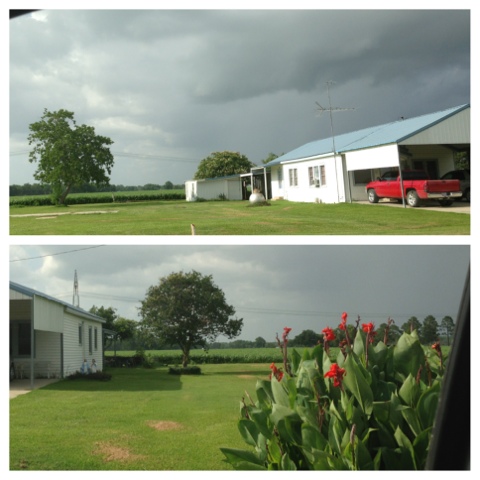
On the way, there is my favorite little homestead: it is a little white house with a blue roof and red truck in the driveway. It is surrounded by the green fields along Jules LaGrange. In the ditch are a big clump of red flowering ginger and in the side yard are hand painted statues of Jesus and Mary. Their house reminds me of the cardinals that swoop across the road along the bayou:


The town of Leonville itself is a little like a 1940's ghost town.  A few hundred people live in quiet, neat houses and trailers, and otherwise, abandoned white structures line the streets. Even the brown Teche flows quietly through with none of the fanfare you would find over it in a place like Arnaudville. At the heart of Leonville is Champagne's grocery, flanked by Leonville Elementary on one side and the rounded bell tower of St. Leo's Church on the other.  Inside I recognized a few of my old students and their growing siblings. I am always greeted with a "Bonjour Madame", even though I only taught French at the high school for five years and haven't taught in three.


D'après moi, Champagnes' Marche' is the perfect local grocery store. They had home-grown cantaloupes, perfectly portioned packs of green beans, soft loaves of sausage-jalapeno-cheese bread and giant boxes of Little Debbie Snacks. I got a six-pack of glass bottle cokes. I especially enjoyed picking out four green pears, whose green color and form seemed to belong in some mystical way to the very fiber of grey Leonville. 

In the parking lot, I saw a plainclothes Father Ken Domingue walk in, red shirt, smiling. He had taught me as a teenager at Sacred Heart in Ville Platte. Other people were pumping gas. There were dark, thin men with their sons, blonde mothers with children, more of my students, and an old couple talking in French. The church bells gonged the half hour. People were going home. 


Near the silos at Mark's Bridge, Mister Simon, expert snake killer and father to les belles filles Stelly was crossing the road near his lovely oak-shaded home on the Coulee. I pulled over briefly to tell him Hey, I almost called you earlier! I had a six foot chicken snake in my cabanne! He laughed. I told him that it got away, and I wanted to use my pistol, but there was cement in the cabanne, and would it ricochet? As I saw a black truck coming up behind me from the fields, Mister Simon said, Oh no, you don't wanna do dat, it'll ricochet bad! and as I drove away, he waved and laughed, Don't do dat!!

Mista Simon, masta snake killa and awesome neighbor! Pic by M. Stelly


 Further up the road, where the new houses (!) are being built, there was my old student the PDF Gazette and another neighbor, Tante Claire, visiting in the yard. I took the chance to pull over, visit for a minute, en Francais meme! and take a couple pictures of the double (triple) Mary Statues in their yard. It was nice to get to talk to the neighbors. I even saw something at their place that I never saw before:

A cement baby Jesus- SHA!!!!!


Prairie Pietà


 Appropriate Double-Grotto Home In the Prairie of the Women


Our Lady, Reine des Guêpes (and there are many on the Prairie!)

You never know the mystical things you will see when you go to Leonville...


Saturday, June 8, 2013

Samida's Voice

One of the things that I love the most about our South Louisiana culture is the observance of feast days of the saints and holy days in the Church. They are like mini-holidays that mark the mundane weeks and months. I love the lore that they hold, and the way that they connect us to our French past. I especially like to observe the feast day of Saint Medard, June 8. When I started to ask questions to my family about local history, "the Samida", as they called it, was always one of the first things to come up. They said that if it rains on this day, it will rain for forth days. If it is dry, there will be a dry spell for 40 days. I loved how my family called it le Samida (it soudned like Sammy-Da). I also especially loved observing the weather on that day, and since it falls at the beginning of the summer season of humidity and looming afternoon storms, it usually will rain, unless we are in drought. I remember years not too long ago when farmers were praying to the Saint for rain. 

With the storms that blow out here on the prairie come the occasion to see les jambes de pluie, the legs of the rain, the local appellation for the streaks that form when falling rain is visible from a distance. I imagine that they were the legs of the Saint, walking across the land, bringing rain with his steps. Today, true to form and seemingly out of the blue, he appeared from the west. I saw les jambes de pluie approach, and, when the storm was upon us, that his legs were actually made of twin lightning strikes. I even heard his voice: 


Samida in the west coming across the Prairie des Femmes

Rain arrives from the West in Acadiana on the Feast of Saint Medard

By the time the storm was hot pink and grey on the Prairie des Femmes, the lights had gone out and it was high time for our afternoon coffee. There was gas for a fire but no water pressure. Lucky I had collected rainwater in a basin on the porch, and so I was forced to drink some Saint Medard rainwater coffee milk. Right after that, the rain stopped and in the east appeared a rainbow. I even think I saw Samida smile.

Samida's upside down smile

Friday, June 7, 2013

Buffy on Saint Medard

File:Saint medard a saint medard d eyrans.jpg
From Wikimedia Commons


Alright bonjour qui c'est qui parle?

Hey This here's Buffy.

Yay! Steve Buffy! Go right ahead-

When does the Simeda start? Da eighth or da tenth of June? 

I think it's the eighth of June, huh? 

...I'm not sure no mo...

...j'crois...comme si il serait le huit de juin qu'est la la fête de Saint Medard. (I think that it'll be the eighth of June that is the feast day of St. Médard)

-Ouais (yeah)

Et là, si ça mouille ce jour là, ça va mouiller pour quarante jours et si ça mouille pas, ça va être sec pour quarante jours, ein? (And if it rains that day, it will rain for forty days and if it doesn't rain, it will be dry for forty days, huh?)

Yep, that's how it goes...

That's how it goes...

From KATC TV3 -Acadiana's News Channel