Showing posts with label Leonville. Show all posts

Sunday, May 24, 2026

Cultural Resources Survey of Four Disposal Areas Along the Vermilion River Lafayette Parish


Cultural Resources Survey of Four Disposal Areas 
Along the Vermilion River Lafayette Parish:
US Army Corps of Engineers

"USL continued to excavate selected sites in the general area. A. Frank Servello conducted test excavations in the Meche-Wilkes Mound (16SL18) on Coulee de Marks between Grand Coteau and Arnaudville in the late 1970s. Coulee de Marks is a tributary of Bayou Fusilier, which is the eastern head branch of the Vermilion River. Gibson continued excavations there in 1989-1991. This site has a low conical mound filled with fragments of Poverty Point objects as well as fiber-tempered and untempered Tchefuncte-like pottery, surrounded by a midden containing untempered Tchefuncte-like pottery (Gibson 1990a:109-lll, 117-118, Tables 26-27). The fiber-tempered pottery is similar to that from the Ruth Canal site, 20km to the south, and these sites, along with a few others bearing fiber-tempered wares in the locality, probably represent a very narrow time interval around 1000 B.C."


"Despite its compact size, Beau Rivage (near the confluence of Bayou Tortue and Vermillion River) had large quantities of exotic rocks—thousands of pieces and possibly hundreds of kilograms. Exotics make up over a third of all lithic materials in the available collection (Gibson 1976a:Table 20). There are at least nine other sites within a 25km radius of Beau Rivage that have exotic materials—materials other than novaculite and quartz crystals, which are not really exclusive Poverty Point commodities (Gibson 1991b). The Olivier site (16SL12), near the junction of Coulee de Marks and Bayou Fusilier, is the most notable of these other sites (Gibson 1976a:38-39). But none of these sites comes close to matching Beau Rivage in absolute quantities, although Olivier might come close in terms of relative quantities. The point to be made here is that Beau Rivage is not an isolated component. For 25km above and below Beau Rivage along the Coteau Ridge and flanking Vermilion swamp are other presumably coeval sites bearing foreign lithic materials. We suspect Beau Rivage was the local supplier. But where did Beau Rivage get the rocks? In an earlier analysis, Gibson claimed that they came directly from the Poverty Point site, 280km to the north {Gibson 1979). Gibson thought they were first delivered to Poverty Point, where they were rendered into tool blanks before they were then shipped on to distant consumers, like Beau Rivage. Now, after more than a decade of recent excavation at Poverty Point have failed to find either the unaltered bulk materials or the primary chipping residue showing that preshaping actually took place at Poverty Point, we are not as certain. Initial shaping of tool blanks for trade now seems more likely to have been carried out at the rock outcrops or deposits themselves. Poverty Point still seems to be the most likely source of the blanks and nodules that got to Beau Rivage, but search for intervening distributors continues."


"...Several San Patrice points were found at Meche-Wilkes Mound, on Coulee de Marks near its junction with Bayou Fusilier"


"Additional Archaic components occur upstream and downstream from Lafayette. Downstream some eight kilometers below the Vermilion River gap is a cluster of sites (16VM7, 16VM17 and 16VM23) near the mouths of Anslem Coulee and Coulee He des Cannes. One of these (16VM23) produced several projectile points (including Evans, Ensor, Benton, and others), point fragments, drills and drill fragments, chipped adzes and gouges and fragments, boatstone fragments, and tubular and barrel-shaped stone beads (Gibson 1976a:Table 23, Figure 10). However, only a handful of flakes was recovered, totally insufficient to complement the number of finished tools on the site. The assemblage is unusual enough to lead us to suspect that it might be functionally specialized, perhaps even ceremonial. Upstream where the river parallels the Coteau Ridge are other Archaic components, and on the low Prairie des Femmes terrace, where flanked by Coulee de Marks between Grand Coteau and Arnaudville, is the oldest Archaic component known in the Vermilion locality. The Coulee de Marks site (16SL48) produced Early Archaic point types, Keithville and Cache River, as well as point fragments and preforms, small flake end scrapers, and chipping residue (Gibson 1990a:Table 24). There was substantial Archaic activity on or near the Vermilion River, and it seems to have spanned much of the long Archaic interval. But precisely when and what forms it took are unknown. We have only the most general perceptions of the interval, but they are sufficient to show that the locality continued to be a favorite spot for native groups. Having a long-standing sizeable population in a place with easy access to the interconnected waterways in the Lower Mississippi Valley was probably a prerequisite for entering into an era of commercial exchange, which characterized the ensuing period."


Wednesday, August 5, 2015

Bayou TĂȘche Treasure

We went down to the Bayou Teche at Leonville in the cool of the evening to run the boat a little. Heard the bells singing from Saint Leo. Spotted some old bottle dumps in the bank. Found some lovely whole blue miniature pottery, a few bottles, and even a footed, gold trimmed, rose teacup with only the handle missing. Can't stop imagining some fancy Leonville lady throwing that out only to have me dig it out of the bank decades later. Thinking of bleaching it well and making it my new favorite cup. 

Update: Caught a heatstroke digging this up.


Thursday, June 13, 2013

Green Pears in Leonville


As my old student Mlle LeMelle used to say. "Nothin's happenin in Leonville. You go to church, you go home." Technically, Leonville is the closest town to the PDF, but I don't often go there lately, mostly because the bridge leading there was out for six months, and because sometimes the big stores up on the Interstate have more selection and fresh fruit. But sometimes you don't want selection or the freshest fruit. Selection is overwhelming and say you want just good old fruit, trucked back on the Teche and displayed at the Marche. On those days, I retreat back into Teche Country, not to the busy Exit 11. Yesterday, I had a sick child and a fussy baby and we were out of milk. It was almost 5 and I wanted to be back home for my afternoon coffee and world news with Diane Sawyer, which is like religion to me. So, at the end of the driveway, I decided today would be a quick trip to Leonville, to the right, through the open fields of Pointe Claire. 

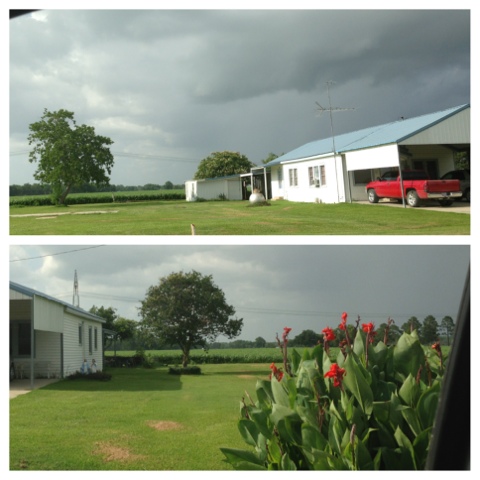
On the way, there is my favorite little homestead: it is a little white house with a blue roof and red truck in the driveway. It is surrounded by the green fields along Jules LaGrange. In the ditch are a big clump of red flowering ginger and in the side yard are hand painted statues of Jesus and Mary. Their house reminds me of the cardinals that swoop across the road along the bayou:


The town of Leonville itself is a little like a 1940's ghost town.  A few hundred people live in quiet, neat houses and trailers, and otherwise, abandoned white structures line the streets. Even the brown Teche flows quietly through with none of the fanfare you would find over it in a place like Arnaudville. At the heart of Leonville is Champagne's grocery, flanked by Leonville Elementary on one side and the rounded bell tower of St. Leo's Church on the other.  Inside I recognized a few of my old students and their growing siblings. I am always greeted with a "Bonjour Madame", even though I only taught French at the high school for five years and haven't taught in three.


D'aprĂšs moi, Champagnes' Marche' is the perfect local grocery store. They had home-grown cantaloupes, perfectly portioned packs of green beans, soft loaves of sausage-jalapeno-cheese bread and giant boxes of Little Debbie Snacks. I got a six-pack of glass bottle cokes. I especially enjoyed picking out four green pears, whose green color and form seemed to belong in some mystical way to the very fiber of grey Leonville. 

In the parking lot, I saw a plainclothes Father Ken Domingue walk in, red shirt, smiling. He had taught me as a teenager at Sacred Heart in Ville Platte. Other people were pumping gas. There were dark, thin men with their sons, blonde mothers with children, more of my students, and an old couple talking in French. The church bells gonged the half hour. People were going home. 


Near the silos at Mark's Bridge, Mister Simon, expert snake killer and father to les belles filles Stelly was crossing the road near his lovely oak-shaded home on the Coulee. I pulled over briefly to tell him Hey, I almost called you earlier! I had a six foot chicken snake in my cabanne! He laughed. I told him that it got away, and I wanted to use my pistol, but there was cement in the cabanne, and would it ricochet? As I saw a black truck coming up behind me from the fields, Mister Simon said, Oh no, you don't wanna do dat, it'll ricochet bad! and as I drove away, he waved and laughed, Don't do dat!!

Mista Simon, masta snake killa and awesome neighbor! Pic by M. Stelly


 Further up the road, where the new houses (!) are being built, there was my old student the PDF Gazette and another neighbor, Tante Claire, visiting in the yard. I took the chance to pull over, visit for a minute, en Francais meme! and take a couple pictures of the double (triple) Mary Statues in their yard. It was nice to get to talk to the neighbors. I even saw something at their place that I never saw before:

A cement baby Jesus- SHA!!!!!


Prairie PietĂ 


 Appropriate Double-Grotto Home In the Prairie of the Women


Our Lady, Reine des GuĂȘpes (and there are many on the Prairie!)

You never know the mystical things you will see when you go to Leonville...


Monday, August 13, 2012

Au Long du Bayou TĂȘche

We took our little bĂąteau out on Bayou TĂȘche at Leonville the other day. Went down to where there is an old dump and bottle bank. I found a couple
of cool old bottles, but being on he bank is sorta scary. It reminded me
of that scene in the movie Labyrinth where they are sinking in the trash. The bank is practically "made" of broken glass and rusted aluminum and metal of all kinds, and covered with a nice layer of bayou mud, leaves and poison ivy. The bank is steep and Il faisait chaud! It was hot out. On the ride back we saw some very strange "brain-like" fruits of the bois d'arc. Back at the new launch across from Champagnes MarchĂ© I found a few more old shards. Some very beautiful ones along the Bayou TĂȘche.

Fruits of the bois d'arc.