Showing posts with label Bayou Bourbeux. Show all posts

Saturday, September 14, 2024

Prairie Des Femmes Water Corporation


Prairie Des Femmes Water Corporation constructs and operates a water distribution system within and for that part of the area within the confines of St. Martin Parish lying within the following area:

Beginning at a point which is the confluence of Bayou Carencro, Bayou Fuselier and the Vermilion River; said point also being the common boundary of St. Landry Parish, St. Martin Parish and Lafayette Parish; thence following the meanderings of Bayou Fuselier in a northerly direction to its intersection with Bayou Bourbeaux; thence following the meanderings of Bayou Bourbeaux in a northwesterly direction to its intersection with the centerline of Louisiana Highway 93; thence in a westerly direction along the centerline of Louisiana Highway 93, a distance of 5,400 feet; thence in a due north direction for a distance of 7,000 feet to Bayou Bourbeaux; thence following the meanderings of Bayou Bourbeaux in a northwesterly direction to its intersection with Coulee de Marks; thence following the meanderings of Coulee de Marks in an easterly than a south-easterly direction to its intersection with Bayou Fuselier; thence following the meanderings of Bayou Fuselier in a south-easterly direction to its intersection with the western corporate limits of the Town of Arnaudville; thence southerly along the western corporate limits line and a projection thereof to the intersection with the centerline of Bayou Pont Brule; thence following the meanderings of Bayou Pont Brule in a southwestern then southerly direction to its intersection with the Lafayette Parish-St. Martin Parish Line; thence westerly along said parish boundary line to its intersection with the centerline of the Vermilion River; thence following the meanderings of the Vermilion River in a north-westerly direction to its intersection with Bayou Carencro and Bayou Fuselier which is the point of beginning.

Sunday, September 8, 2024

The Protection of the Academy


The Grand Coteau was high holy ground before the Jesuits settled it for Catholic formation of their religious and then the religious of the Sacred Heart. There is an oral history that says it was there native men went to fight with honor. At the westernmost ridge of the old Mississippi River, and near the tribal boundary of the Attakapas-Ishak and Opelousas, this seems plausible.  The elevation alone made this land some of the finest and safest around. Grand Coteau is found at the uppermost limits of the Prairie Carencro, on land on the Teche Ridge that was also called Prairie des Grands Coteaux.  Despite some overlap in orientation, both topographically and culturally, the Grand Coteau is singular and known as holy land in south Louisiana folklore. 

The prairies, ridges, swamps and coves of south Louisiana overlap and interplay.  The edges of the Prairie des Femmes have a liminal quality that matches her landscape and they mystery of the women's protection she provides. Grand Coteau is the high ridge directly east and adjacent to Prairie des Femmes, and the same stretch of Bayou Bourbeaux that acts as PDF's western limit also runs through the Academy of the Sacred Heart at Grand Coteau's realm, less than a half mile from the school. No place is closer to the Praire des Femmes both physically and spiritually, as Grand Coteau, as they share this history of being a mystical place of women's protection. The Academy is the second oldest institution of learning west of the Mississippi River and also the site of a shrine to Saint John Berchman, who appeared there to novice Mary Wilson and healed her through his intercession. This is the reason the Academy is the only place where a recognized miracle took place in North America.  Today as I write, the shrine sits directly above my classroom. 

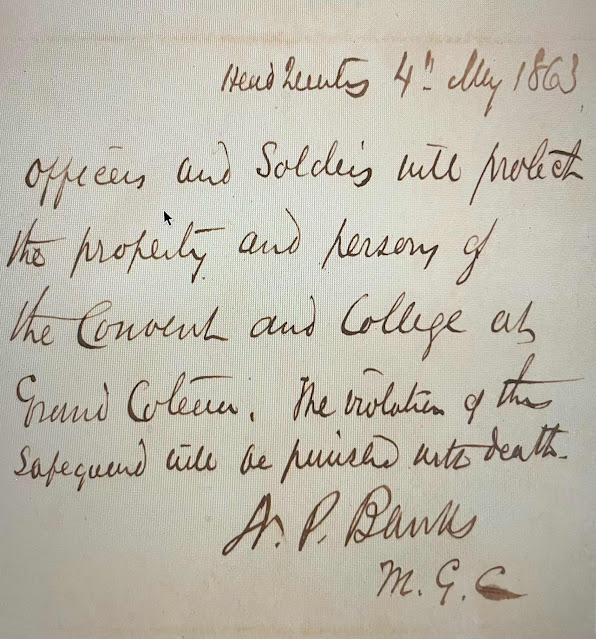
The Academy served as a safe haven for women and children through the Civil War. The school was protected by the Union and instruction of the girls never ceased. Because of this protection, within the Sacred Heart, and also due to the communication of industrious women, it was not burned, and the Academy and town of Grand Coteau stand still in operation today. 

The convent of the Sacred Heart was founded in Grand Coteau in 1821 by the Religious of the Sacred Heart and had five students that year. In 1861 the Civil War's skirmishes around Bayou Bourbeaux (Battle of Buzard's Prairie at Chretien Point and east along the bayou) were audible from the school and the nuns reported seeing the battle from the third floor gallery. They began to fear for the school and the girls' safety. 

In 1862 General Nathaniel Prentice Banks became the commander of the Department of the Gulf. He and his wife Mary Theodosia Palmer Banks had a daughter in a Sacred Heart school at Manhattanville, New York.
The following is correspondence between Mother Jouve and General Banks concerning the protection of the Academy: 

Notes from Reverend Mother Jouve, July 1864


Thanks to the protection of the generals, or rather to the Heart of Jesus, our property has been respected, and guards have been sent by the officers to protect us from the marauders who infest the area. For more than two months, we heard the noise of the cannons; some of the skirmishes took place on the road which leads to the convent, and from our gallery we were able to follow the phases of a real battle between the Confederate guerillas and the Federal troops.

In these moments of crisis, prayer was constantly our recourse, the Way of the Cross, adoration all day and the Holy Hour at night, the most exact practice of the Rule. Finally, the certitude that our Mothers and Sisters were praying for us, all combined to sustain our courage, and to help us to live through this time of trial with calm and confidence."


20 April 1863

To the Superior of the Convent of the Sacred Heart-

If you desire to send letters to New York, you will please forward them to me by the bearer who is instructed to wait for them. I send a safeguard that will protect your school from the stragglers in the rear of my column and if you desire it will leave a guard. I regret that I cannot call to see you. My daughter is with Madame Hardey at New York.

Mrs. Banks who visited the school but a short time since writes that all are well there.

I am respectfully your obt servant,

N.P. Banks


*Mary Aloysia Hardy ppt compiled by Caroline Richard 2020


The Union did not only protect the Academy with stationed guards, but provided the sisters and the girls food and bolts of fabric for new clothes.  As far as oral histories of Prairie des Femmes go, the most available in the mind of the people is the one owes the name to the Civil War. Though the name is older than the war, and probably refers to some native wars also, I often wonder if reports of forts and extreme refuge found here rest in the power of the memory of the protection of the women and children of the Convent of the Sacred Heart at Grand Coteau under penalty of death.


Thursday, October 23, 2014

Thing they should sell at the Prairie des Femmes Store

I went there once on la Fete de la Chandeleur to grab nearly all of their eggs and milk because we were short for crepe making at Beau Chene High School. I think I also bought a Mexican coke. They should sell basics like that at the Prairie des Femmes store, and other stuff like bags of Creole Rose rice and cans of Rotel, white cherry icees and boudin balls and boules rouges in big glass jars on the counter, of course, but if I had my way, this is what they would also sell at the Prairie des Femmes store (on the old Indian footpath that is now Hwy 93) but because that spot is built on an ancient mound site, everyone around here says nothing takes there and stores can't stay in business. No business, no matter how successful, lasts more than a year or two at that location. 

  1. powder puffs of thistle tops used to apply powder of the crushed Cherokee rose
  2. fresh pucks of wax-myrtle wax 
  3. bay and beeswax candles
  4. cypress blood, tincture of cypress sap, bottled and corked
  5. Spanish moss in a can, match included 
  6. iron tines of the plow for t-fer making
  7. hats and fans of the latanier for ladies to keep cool in the summertime
  8. smudge sticks of indian sage, lemonbalm, rabbit tobacco
  9. dried teas of herbe a cabri, mugwort, mongrea
  10. sasafrass root
  11. file' powder
  12. comb-in prairie des femmes honey
  13. pecan shell berceuses pour les ti-catins
  14. dried French mulberries by the lb
  15. fresh mulberries, dewberries, blackberries in season
  16. white mulberries of the Bayou Bourbeau in season
  17. elderberry syrup for the winter and dried elderberry flowers
  18. wooden beads and raw leather for leather work
  19. Laguiole knives with the bee and goat punch
  20. black taribi, cabresse
  21. bousillage soap bar
  22. red powder made from the crushed shells of lady bugs
  23. job's tear and chinaberry rosaries
  24. blow guns of lilas parasol
  25. shovels
  26. seeds
  27. Poo yaille fertilizer
  28. hammers
  29. basins and buckets of all sizes
  30. rolls of thick brown paper
  31. cast iron cookware
  32. a directory of the names of local traiteurs on a cork board
  33. Louisiana literature and music
  34. quilts
  35. A Prairie des Femmes Field Guide
  36. ceramic shards from the field, embossed with gold
  37. plantain t-fer salve
  38. homgrown fruits and vegetables
  39. lemonbalm tingture
  40. loose manglier tea
Don't try to pull in or turn around at the old Prairie des Femmes store, though! They got the driveway lined with nail boards. 


The Enchanted Prairie des Femmes

And have you seen the dragon who guards the bridge at Frozard?


I knew the Prairie des Femmes was enchanted because she was so unassuming, and so one day we set out across Monsieur Vacheur's  back pastures and then on to the other side, where there is a little grove of trees in a small l'anse of the prairie. There we found all kinds of evidence of fairy activity: acorn caps fashioned into hats and piles of hickory nuts like pyramids, the abandoned wings of the demoiselle fly, their forlorn iridescence catching my eye. There were spider webs along the ground (the tiny elves like to take their morning drink from the dew that gathers in droplets) and mossy green couches where they reclined in the roots of a cypress tree. There were new leaves freshly impaled on twigs scattered about (fairy flags) champignons of red and grey, and even green rings where they had danced the new moon before. But to be sure, I saw no fairies or elves or nains or even lutins, only their evidence. I knew that they were there, though, because after my journey to the l'anse, at dusk I could see the thin plumes of smoke rising like grey threads above the treeline; at night, the candle-flicker of their fires in the wood. Sometimes, I could hear the Indian drums and knew they danced to them in fairy rung:


In the spring, we went onto the ancient Bayou Bourbeau that borders the enchanted prairie. Up to the Grand Chemin halfway to Opelousas we went to put the canoes in the bayou. We came all the way down, behind the Academy of the Sacred Heart, we rested at the old wooden bridge covered in white blackberry flowers, and stopped to pick a few of the early dewberries.  Down the Bourbeau's green banks at narrow spots there were so many adolescent black moccasins, that they struck at the paddles and at the boat from the water and banks alike, until we made a game of bopping their hissing heads with our paddles. We floated along under a stripped umbrella and found white spider lilies and picked one for the mast of the ship. Further down where the brown water widened, there were white mulberry trees lining both banks of the muddy Bourbeau, and we picked and shook the trees until the berries fell like fat pink and white drops of rain.


Then one day in a rush I chanced upon a curious fellow, a centaur on the Prairie des Femmes road! He was all in brown and bareback'd with no identifying qualities that would place him in this century or the last. I had to stop to speak to him, to make sure he was not an apparition (as they are as likely on the Prairie des Femmes road as a centaur)  and though I spoke, he gave a sheepish smile but never replied except for a neighing sigh I heard as I turned. As he rounded the third curve, I snapped this photograph, and surely if I had not, you would believe my story or that the Prairie des Femmes was truly enchanted and maybe neither would I.


But then on the morning of the winter solstice, I received the biggest conformation of all! I happened to pass the Queen of the Prairie des Femmes in her grand Chariot en Paille, led by her entourage of black curs. She was wearing her magenta mantle, trimmed in brown furs! She did not stop, but gave me a gentle nod, for she was working to move the hay, for queens of this prairie must tend the herds, even on the darkest day! 


Monday, May 6, 2013

Prairie des Femmes in Lore and History


Descendants of Michel CORMIER (1741-1790)
 
Michel, son of Pierre dit Palette Cormier and Cécile Thibodeau of Chignecto, younger brother of Joseph and first cousin of Jean-Baptiste, fils, married Anne dite Nanette, daughter of Jacques Sonnier of Petitcoudiac, sister of brother Joseph's first wife, and widow of Basile Babin, at Opelousas in c1769.  Anne died in early 1773, and Michel remarried to Catherine, daughter of German Creole neighbor Johann Georg Stelly, at Opelousas in c1774.  Michel remarried again--his third marriage--to Madeleine, daughter of fellow Acadian Charles Breaux and widow of Étienne Benoit, at Attakapas in February 1789; Madeleine was 20 years younger than Michel and was his wife for less than two years.  Michel and his wives did well on the Opelousas prairies.  In March 1768, he, along with brother Joseph, were among the 11 signers of a petition addressed to Spanish Governor Ulloa requesting assistance in the form of oxen and plows to help them grow wheat in the district; in April, the governor, now angry with all Acadians in the colony, rejected the petition.  After the revolt against Ulloa, in which he and his Opelousas comrades probably did not participate, he signed with his mark an unconditional oath of allegiance to Spain in December 1769.  In the years that followed, he became a cattleman, not a wheat farmer.  In August 1771, Governor Unzaga granted him 253.04 arpents of land, to be occupied and cultivated, on Bayou Bourbeaux between present-day Leonville and Arnaudville, St. Landry Parish.  His house at Prairie des Femmes on Bayou Bourbeaux, "built prior to 1773 ... on ground level with 'poteaux-en-terre, ... had bousillage walls, and a dirt floor, and a gallery or porch surrounding the house."  In 1771, the year he received his land grant, Michel owned 28 head of cattle.  Three years later, he owned 20 head of cattle, 6 horses and mules, and 16 pigs.  In 1777, he owned 50 head of cattle, 16 horses, and 16 pigs.  His fortunes increased dramatically in the 1780s.  In 1788, on his vacherie at Prairie des Femmes, Michel owned a herd of 130 cattle and 15 horses.  He also owned seven slaves.  Meanwhile, as was his duty, he served in the Opelousas company of militia.  He was a fusileer in 1776, described on the militia roll as 5 feet, 4 inches tall, an inch taller than his brother Joseph.  Three years later, in their late 30s, Michel and Joseph participated with their company in Governor-General Gálvez's attack against the British at Baton Rouge.  Michel died at his home at Prairie des Femmes in December 1790, without benefit of sacraments; he was only 49 years old.  According to family tradition, he was buried in what became the old yellow fever cemetery at present-day Washington, St. Landry Parish.
+++++++++++++++++++++++++++++++++

Articles by Floyd Knott:
 
 In the mid-1900s, some of the favorite places to dance to Cajun music were the Silver Slipper and the Happy Landing in Pecaniere. It was there, as a youngster, that I met many people from Prairie des Femmes (femmes is French for women). Prairie des Femmes is a community between Grand Coteau, Arnaudville and Opelousas. I was always amazed at the large number of girls from the same family at the dances. One family had eight girls and only one male. Although to a smaller degree, I observed the same pattern with other families. So it was easy to make the assumption that the community was so named because females outnumbered males.

Recently I met Mrs. Marks, an elderly lady from that community. When she introduced herself as coming from Marks Bridge of the Prairie des Femmes area, my curiosity was again aroused. She joked about all the Marks, Quebedeaux, and Lagrange girls in her neighborhood when she was young. So I asked her if she knew the reason why it was so named. I was familiar with the origin of the Marks Bridge name but Prairie des Femmes was only speculation — and indeed when I posed the question she gave me a different explanation from the one I had assumed.

She told me that her grandfather had always told her that during the Civil War most battles were fought along Bayou Teche and Bayou Bourbeau and that before the battles, the menfolk would move the women and children to the safety of the prairie and that was the reason it was called Prairie des Femmes.


+++++++++++++++++++++++++++++++++

Oral history is sometimes not entirely accurate. One of the many enjoyments I get from writing articles about old times is the many comments from the readers about different versions of events from the past that they have heard from there elders. Such was the case about the origin of the name Prairie Des Femmes, a community in St. Landry Parish. Apparently the version expressed earlier about the name coming as a result of the Civil War battles was not correct because additional research indicates that the name was in use as early as 1809. Father Hebert’s earliest document in which Prairie Des Femmes was mentioned was a memo written in 1809 from the cattle warden. A document, “Police des Animaux,” which authorizes the picking up of all stray cattle in the District of Grand Coteau, Prairie Des Femmes and Carencro, was signed by George King, parish judge. Prairie Des Femme was mentioned quite frequently by Father Hebert in his research from 1809 to 1830 – years before the Civil War.

David Lanclos has a different explanation:

“I have also heard a version of the story about how the place came to be called by that name. The story goes that as Indian groups traveled through their hunting grounds they often set up camps on the various prairies that bordered Bayou Teche. According to the story, Indians had set up a camp at the place we know today as Prairie Des Femmes. When they decided it was time to move on, there were several women who were too old or too sick to travel. As was often the custom of these Indians, the old women were abandoned at that place, where they were eventually discovered by early settlers who lived in the area. The place thus came to be called Prairie Des Femmes.”

Is this the true story? Who knows, but if we keep exploring it, sooner or later, a definitive version about the origin of the name Prairie Des Femmes is bound to emerge. If anyone has heard a different version, please contact me.

Read more: ZacharyToday.com - Les Vieux Temps by Floyd Knott

+++++++++++++++++++++++++++++++++

Here is the earliest documentation on a map of the Prairie des Femmes that I have found on the Carte générale du Territoire d'Orléans comprenant aussi la Floride Occidentale et une portion du Territoire du Mississipi by Barthélémy Lafon.
See Prairie des Femmes in the crook of the bayous under the last S of Oppeloussas (Deail of Carte générale du Territoire d'Orléans comprenant aussi la Floride Occidentale et une portion du Territoire du Mississipi, 1806)
Carte générale du Territoire d'Orléans comprenant aussi la Floride Occidentale et une portion du Territoire du Mississipi
1806; engraving by Barthélémy Lafon;
The Historic New Orleans Collection, bequest of Richard Koch (1971.52)

Monday, August 6, 2012

Les Vieux Temps article about PDF

Mr. Floyd Knott's Les Vieux Temps article about la Prairie des Femmes.

"In the mid-1900s, some of the favorite places to dance to Cajun music were the Silver Slipper and the Happy Landing in Pecaniere. It was there, as a youngster, that I met many people from Prairie des Femmes (femmes is French for women). Prairie des Femmes is a community between Grand Coteau, Arnaudville and Opelousas. I was always amazed at the large number of girls from the same family at the dances. One family had eight girls and only one male. Although to a smaller degree, I observed the same pattern with other families. So it was easy to make the assumption that the community was so named because females outnumbered males.

Recently I met Mrs. Marks, an elderly lady from that community. When she introduced herself as coming from Marks Bridge of the Prairie des Femmes area, my curiosity was again aroused. She joked about all the Marks, Quebedeaux, and Lagrange girls in her neighborhood when she was young. So I asked her if she knew the reason why it was so named. I was familiar with the origin of the Marks Bridge name but Prairie des Femmes was only speculation — and indeed when I posed the question she gave me a different explanation from the one I had assumed.

She told me that her grandfather had always told her that during the Civil War most battles were fought along Bayou Teche and Bayou Bourbeau and that before the battles, the menfolk would move the women and children to the safety of the prairie and that was the reason it was called Prairie des Femmes." Floyd Knott

Sunday, August 5, 2012

La Prairie des Femmes


La Prairie des Femmes (Women's Prairie) is a pre-colonial prairie name, located in Saint Landry Parish, Louisiana that borders an oxbow-shaped swamp to the north, Bayou Bourbeau to the west, and Pointe Claire to the east. Prairie Laurent is to the north/northwest and la Prairie Basse to the south. The nearest town is Leonville, and the towns of Arnaudville (La Jonction) and historic Grand Coteau are nearby. Coulée des Marks runs through la Prairie des Femmes and creates a cypress basin at the country intersection of Thomassee and Jules Lagrange roads at Pont des Marks, or Mark's Bridge.

Prairie des Femmes appears on detailed maps of the region as early as 1806, having been inhabited by French Creoles well before this time. The prairie was at the border of the Atakapas and Opelousa tribe's territories, so there was much Indian traffic through the area. Legend has that the area was a high land, a safe zone near the bayous where Native American women lived together while the men hunted or warred with neighboring tribes. Another story says that in Louisiana's historic flood of 1927 that woman and children were sent there from neighboring communities because of its safety. Another tale sites the area as a place where the widows of the soldiers of the Civil War settled to live the remainder of their lives in peace. The most likely story of the origin of the name Prairie des Femmes has two versions: One is that the natives inhabiting the prairie moved after a hunt, as was custom. A few of their old women were left at  the camp being too old to move. The other version is similar, but is more mysterious: that the braves went off one day on a hunt leaving the women and children and simply never came back.  The women left there were discovered by the French Creoles and Acadians who settled the area who called it La Prairie des Femmes.