Showing posts with label Civil War. Show all posts

Saturday, April 11, 2026

Gold Confederate Buttons in Grand Coteau

Civil War General wrote this in his book published in 1879.
"On an occasion, passing the little hamlet of Grand Coteau, I stopped to get some food for man and horse. A pretty maiden of fifteen springs, whose parents were absent, welcomed me. Her lustrous eyes and long lashes might have excited the envy of " the dark-eyed girl of Cadiz." Finding her alone, I was about to retire and try my fortune in another house ; but she insisted that she could prepare "monsieur un diner dans un tour de main," and she did. Seated by the window, looking modestly on the road, while I was enjoying her repast, she sprang to her feet, clapped her hands joyously, and exclaimed : " Voila le gros Jean Baptiste qui passe sur son mulet avec deux bocals. Ah ! nous aurons grand bal ce soir." It appeared that one jug of claret meant a dance, but two very high jinks indeed. As my hostess declined any remuneration for her trouble, I begged her to accept a pair of plain gold sleeve buttons, my only ornaments. Wonder, delight, and gratitude chased each other across the pleasant face, and the confiding little creature put up her rose-bud mouth. In an instant the homely room be- came as the bower of Titania, and I accepted the chaste salute with all the reverence of a subject for his Queen, then rode away with uncovered head so long as she remained in sight. Hospitable little maiden of Grand Coteau, may you never have graver fault to confess than the innocent caress you be- stowed on the stranger ! It was to this earthly paradise, and upon this simple race,  that the war came, like the tree of the knowledge of evil to our early parents..."
Merci Madeline of Mimosa for passing this information along


Sunday, September 8, 2024

The Protection of the Academy


The Grand Coteau was high holy ground before the Jesuits settled it for Catholic formation of their religious and then the religious of the Sacred Heart. There is an oral history that says it was there native men went to fight with honor. At the westernmost ridge of the old Mississippi River, and near the tribal boundary of the Attakapas-Ishak and Opelousas, this seems plausible.  The elevation alone made this land some of the finest and safest around. Grand Coteau is found at the uppermost limits of the Prairie Carencro, on land on the Teche Ridge that was also called Prairie des Grands Coteaux.  Despite some overlap in orientation, both topographically and culturally, the Grand Coteau is singular and known as holy land in south Louisiana folklore. 

The prairies, ridges, swamps and coves of south Louisiana overlap and interplay.  The edges of the Prairie des Femmes have a liminal quality that matches her landscape and they mystery of the women's protection she provides. Grand Coteau is the high ridge directly east and adjacent to Prairie des Femmes, and the same stretch of Bayou Bourbeaux that acts as PDF's western limit also runs through the Academy of the Sacred Heart at Grand Coteau's realm, less than a half mile from the school. No place is closer to the Praire des Femmes both physically and spiritually, as Grand Coteau, as they share this history of being a mystical place of women's protection. The Academy is the second oldest institution of learning west of the Mississippi River and also the site of a shrine to Saint John Berchman, who appeared there to novice Mary Wilson and healed her through his intercession. This is the reason the Academy is the only place where a recognized miracle took place in North America.  Today as I write, the shrine sits directly above my classroom. 

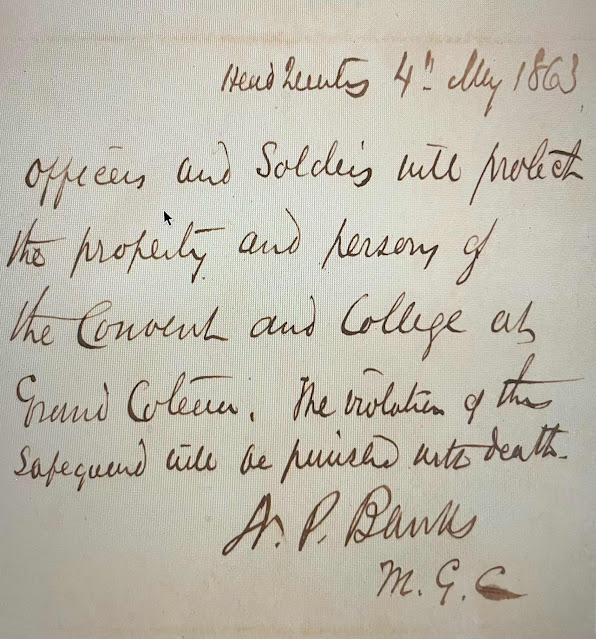
The Academy served as a safe haven for women and children through the Civil War. The school was protected by the Union and instruction of the girls never ceased. Because of this protection, within the Sacred Heart, and also due to the communication of industrious women, it was not burned, and the Academy and town of Grand Coteau stand still in operation today. 

The convent of the Sacred Heart was founded in Grand Coteau in 1821 by the Religious of the Sacred Heart and had five students that year. In 1861 the Civil War's skirmishes around Bayou Bourbeaux (Battle of Buzard's Prairie at Chretien Point and east along the bayou) were audible from the school and the nuns reported seeing the battle from the third floor gallery. They began to fear for the school and the girls' safety. 

In 1862 General Nathaniel Prentice Banks became the commander of the Department of the Gulf. He and his wife Mary Theodosia Palmer Banks had a daughter in a Sacred Heart school at Manhattanville, New York.
The following is correspondence between Mother Jouve and General Banks concerning the protection of the Academy: 

Notes from Reverend Mother Jouve, July 1864


Thanks to the protection of the generals, or rather to the Heart of Jesus, our property has been respected, and guards have been sent by the officers to protect us from the marauders who infest the area. For more than two months, we heard the noise of the cannons; some of the skirmishes took place on the road which leads to the convent, and from our gallery we were able to follow the phases of a real battle between the Confederate guerillas and the Federal troops.

In these moments of crisis, prayer was constantly our recourse, the Way of the Cross, adoration all day and the Holy Hour at night, the most exact practice of the Rule. Finally, the certitude that our Mothers and Sisters were praying for us, all combined to sustain our courage, and to help us to live through this time of trial with calm and confidence."


20 April 1863

To the Superior of the Convent of the Sacred Heart-

If you desire to send letters to New York, you will please forward them to me by the bearer who is instructed to wait for them. I send a safeguard that will protect your school from the stragglers in the rear of my column and if you desire it will leave a guard. I regret that I cannot call to see you. My daughter is with Madame Hardey at New York.

Mrs. Banks who visited the school but a short time since writes that all are well there.

I am respectfully your obt servant,

N.P. Banks


*Mary Aloysia Hardy ppt compiled by Caroline Richard 2020


The Union did not only protect the Academy with stationed guards, but provided the sisters and the girls food and bolts of fabric for new clothes.  As far as oral histories of Prairie des Femmes go, the most available in the mind of the people is the one owes the name to the Civil War. Though the name is older than the war, and probably refers to some native wars also, I often wonder if reports of forts and extreme refuge found here rest in the power of the memory of the protection of the women and children of the Convent of the Sacred Heart at Grand Coteau under penalty of death.


Tuesday, September 3, 2024

Prairie des Femmes Origin Stories

 Prairie des Femmes

Coming to the Prairie and Staying


When I arrived here in 2004 my neighbors called the area Leonville or Anaudville, for the bayou villages to the extreme north and east of the prairie, respectively. There was no marker, no sign and no online presence of the pre-colonial Prairie des Femmes, save for topographical maps where she was marked at Coulee des Marks bridge, and two inquisitive articles published in the Teche News by Mr. Floyd Knott.  If I am completely honest, there was also a wood routed sign that said Prairie des Femmes on a neighbor's chicken coop up by the Bayou Bourbeux that I spied through the trees.  

 The romance of the name seemed to me incongruent with the general knowledge of her existence. I was from another village, called la Ville Platte further to the north in Evangeline Parish. Around la Ville we had many other lieu-dits, les petits places, where we visited and that were part of the common vernacular of life. There was Chataignier, of course, and halfway there, la Pointe Bleue and L'anse Aux Pailles. We frequented Faubourg, Tate Cove, L'anse des Belaire, Vidrine, Redell, and L'anse Grise beyond. I was familiar with these places, yet just 20 minutes from my hometown, I had moved to this women's place whose history and terrain felt remote and largely unexplored. 

Louisiana French connected me more closely to my state, her French and native memory and my place within it all. I began to gather maps, records and historical research as well as personal stories about how the prairie was named: her origin stories. It was clear that these are all native lands and la Prairie des Femmes is a reminder. The neighbors reported the prairie was a place where women and children were found living when the men left for one reason or another. If I asked, they pointed me to the Civil War as origin of the mens' absence, but the records I found suggested that the prairie had a longer memory.

  One local said he believed that the girls outnumbered the boys at the house dances, and that the Stelly, Marks and Quebedaux families produced them. Another story says that in Louisiana's historic flood of 1927 woman and children were sent here from neighboring communities because of its relative safety. (The prairie is at some elevation, but I am still not sure what parts of her flooded in '27) Another tale sites the area as a place where the widows of the soldiers of the Civil War settled to live the remainder of their lives in peace. Some say the women of the area refuged back here when the skirmishes along the bayou Bourbeaux, at Grand Coteau and Chretien Point made it unsafe for the women and children in town. Some reported that the women were left here to farm while the men fought for the Civil War, WW1 or WW2. Some locals even pronounce it "prairie des fermes" and will connect the name to the women farming, or the fact that there are still many agricultural fields here. Another neighbor gave me the rough coordinates of a "fort" that existed here for the protection of the women. 

The most likely story of the origin of the name Prairie des Femmes is the native one, of course. The prairie is a pre-colonial, native place, located at the historical boundary of the Attakapas-Iskak and Opelousas tribal lands. It is named for bands of Ishak and earlier Tchefuncte people who used the prairie was a backwater refuge for their women and children away from the major rivers and bayous of the time. Prairie des/aux Femmes appears on detailed maps of the region as early as 1806. Because of the prairie's central and borderland location, there was much native traffic and infrastructure here. 

Legend has that the area was a high land, a safe zone near the bayous where women lived together while the men hunted or warred. There are a few versions of this story. One is that the male natives inhabiting the prairie moved after a hunt, as was custom. A few of the women stayed at the camp, being too comfortable to move.  Another version says that the prairie was used in ancient times as an off-river refuge for the women that protected them until the men came back. The men were always leaving for war or hunting in the stories. Another says that the male hunters, or bears, went on a hunt leaving their wives on the prairie. The women left there were discovered by the French Creoles and Acadians (Michel Cormier) who settled the area and called it la Prairie aux Femmes. (In Louisiana vernacular the contraction des and aux ((of/to/at the)) are both used when showing possession, aux being older. I have found both des and aux on maps of the prairie) I am often curious if the name is a direct translation of the indigenous name for the place, and if so what the old name was. One of my neighbors had his explanation, offering "that's an old name, yeah." After 20 years of research, this seems to be the most accurate detail of all. 


Friday, May 17, 2013

Civil War Fort at Prairie des Femmes?


According to a local lady, the Prairie des Femmes was named for  a fort located there during the American Civil War used to house women and children away from the battles along the Bayou Bourbeux, which borders the Prairie.

"Prairie des Femmes was actually named for a fort that was built to house women and children during the civil war. Although I am uncertain of the location's actual coordinates I do know it is located North of Fuselier Rd, East of Jules Lagrange Road and South West of Pointe Claire Hwy. The area is somewhere within 3 miles as the crow flies of my family home. We have found many artifacts while excavating a parcel of land bording a patch of woods. We have found Various items like dishware, utensils, the metal component of a muzzle firearm containing the firing mechanisms and trigger, grinding stones and many native American artifacts as well." 2013 TQ


Battle of Bayou Bourbeux

While I like the romantic idea of a fort, the name Prairie aux Femmes (!!!) can be seen on this 1806 map by B. Lafon, which predates the Civil War by more than 50 years.

Lafon’s General Map of Louisiana (1806)

Prairie Aux Femmes


The notion that the Prairie des Femmes has been a place of refuge for women and children is prevalent in all of the local lore about it, and the old-timers will site that it was where the women and children took refuge during the Civil War or other dangerous times. Was there really a central place, a fort or enclosure, possibly built by the men, where women stayed safe, or is this a misunderstanding of the meaning of place of refuge?

Here is a very approximate location of the fort at Prairie aux Femmes:


Can you Spot the Fort?
Prairie des Femmes fence line

Friday, August 10, 2012

Update les Vieux Temps article by Floyd Knott

Click here for Les Vieux Temps Article UPDATE Oral history is sometimes not entirely accurate. One of the many enjoyments I get from writing articles about old times is the many comments from the readers about different versions of events from the past that they have heard from there elders. Such was the case about the origin of the name Prairie Des Femmes, a community in St. Landry Parish. Apparently the version expressed earlier about the name coming as a result of the Civil War battles was not correct because additional research indicates that the name was in use as early as 1809. Father Hebert’s earliest document in which Prairie Des Femmes was mentioned was a memo written in 1809 from the cattle warden. A document, “Police des Animaux,” which authorizes the picking up of all stray cattle in the District of Grand Coteau, Prairie Des Femmes and Carencro, was signed by George King, parish judge. Prairie Des Femme was mentioned quite frequently by Father Hebert in his research from 1809 to 1830 – years before the Civil War.

David Lanclos has a different explanation:

“I have also heard a version of the story about how the place came to be called by that name. The story goes that as Indian groups traveled through their hunting grounds they often set up camps on the various prairies that bordered Bayou Teche. According to the story, Indians had set up a camp at the place we know today as Prairie Des Femmes. When they decided it was time to move on, there were several women who were too old or too sick to travel. As was often the custom of these Indians, the old women were abandoned at that place, where they were eventually discovered by early settlers who lived in the area. The place thus came to be called Prairie Des Femmes.”

Is this the true story? Who knows, but if we keep exploring it, sooner or later, a definitive version about the origin of the name Prairie Des Femmes is bound to emerge. If anyone has heard a different version, please contact me.

Comments about Les Vieux Temps articles are always appreciated. Please call (337) 754-9980 or e-mail yknott123@aol.com