Showing posts with label Frozard. Show all posts

Monday, September 7, 2026

Prairie des Femmes Earth Pigments

​I spent this Labor Day weekend here in the Prairie participating in Monique Verdin's annual land celebration here at her land in the Prairie. 

On Saturday I gave a workshop on vineraire to a group of women and we made smudges and drank iced mint tea. 

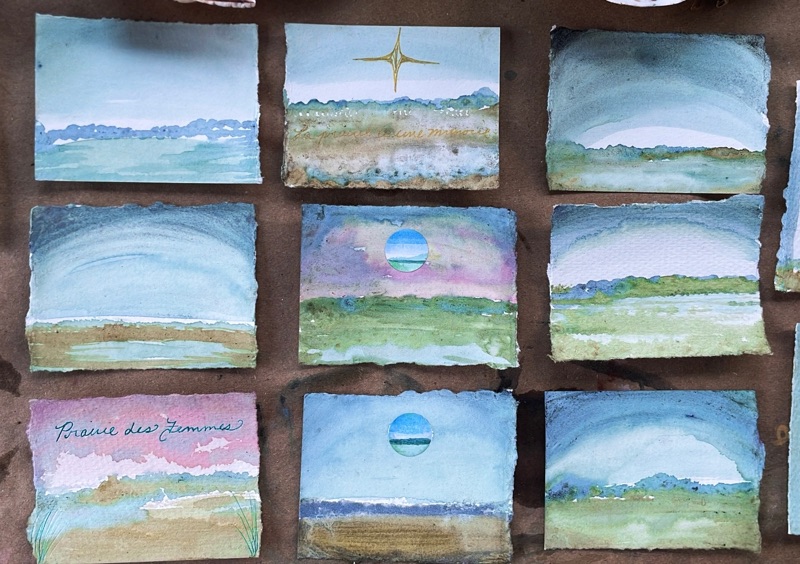
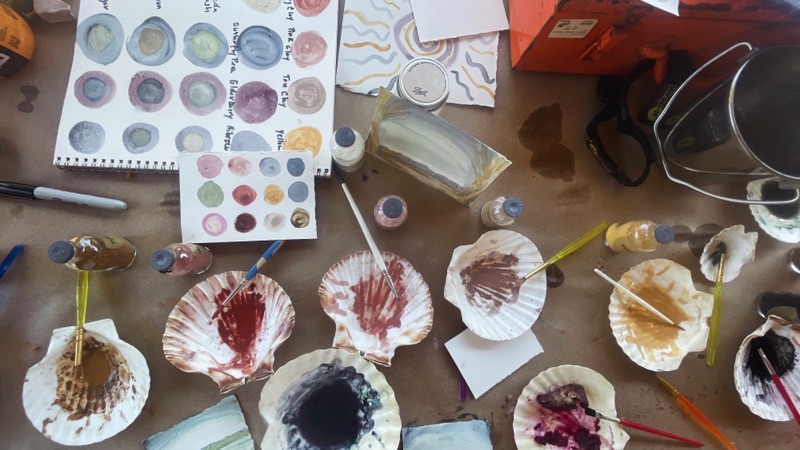
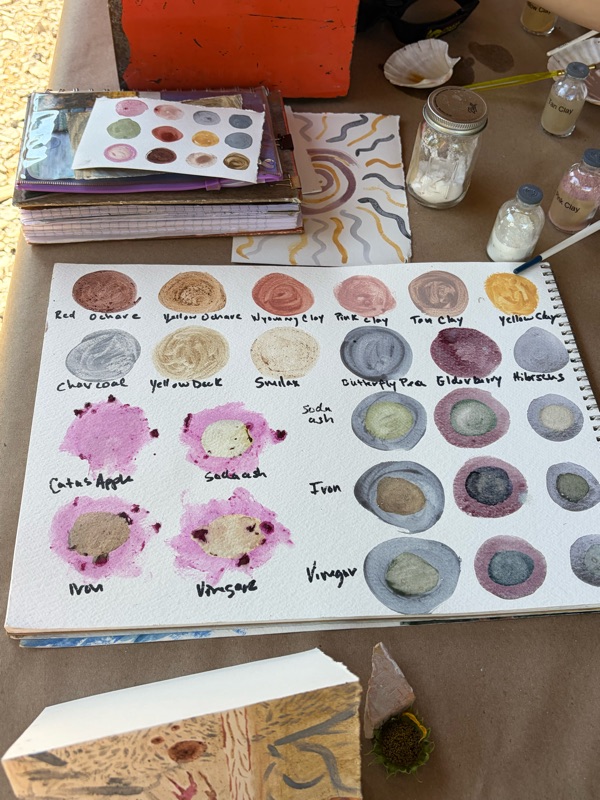
On Sunday we had a party with lots of good food. Joey made white beans and sausage on the braise and there was so much watermelon and fresh boiled shrimp I ate until I couldn't anymore. The most special part besides the superlative group of herbalists, artists, writers, producers, professors and generally lovely friends Monique brings together so often was the earth pigment paints hand made and provided by Tammy Greer. Like Monique she is a member of the United Houma Nation and specializes in making paints and dyes with natural materials. She generously allowed us to paint with her assortment of powders we reconstituted with water. There were red and yellow ochres and pink clays from far north. We used blue butterfly pea powder, charcoal, smilax, elderberry, prickly pear, hibiscus and yellow dock.


Friday, June 26, 2026

Sale of Land of Michel Cormier

 Michel Cormier was an Acadian who settled the Prairie des Femmes prior to 1773. Here is some information about him through Acadians in Gray. 


Monday, May 27, 2024

Venéraire Part 4: The Identification Process

 Part 1: Rabbit Tobacco 

Part 2: The Bottleneck 

Part 3: Critical Mass of Plant Medicine

The ID Process

I identify plants for my own purposes by smell. I was always a tire-feuille (leaf puller) and when the native knowledge came to me, it worked because I had known plants by smell since I was a child.  The smell of a plant tells me much of what I need to know, but I would’t use a plant seriously or on anyone else without a level of certainty that comes with formal identification experience.  My main tool of identification was the Vermillionville Healer’s Guide. I also used Richard Guidry’s Les Arbres de la Louisiane, The Charles Bienvenue thesis, elders of my community, comparison, books, Native Ethnobotany website, google searches and plant ID apps that were becoming more popular and reliable. My identification process could go on for days, weeks, months or years, and always had multiple levels depending on the season and environmental conditions. I liked to know the plant in all her seasons. I knew the old names and remedies, could feel the plant’s energy and hypothesize the uses, but as a teacher I knew the Latin names were a code that I had to know. All in all, I had reliable instincts.


When identifying the rabbit tobacco I had to take into consideration all of the common names both in French and English and a few Latin names that had changed and evolved over the years.  These plants are in the aster family and all take the common names of rabbit tobacco, everlasting or cudweed. Sometimes one specimen had all three common names depending on area. 


 There was pearly everlasting (anaphalis margaritacea) and prairie everlasting (antennaria neglecta). The plant in my field was fragrant white rabbit tobacco,  pseudoghaphalium obtusifolium, and not the early rabbit tobacco (gamochaeta purpurea) that was so common to this place. The Healer’s guide listed patte de chat (gnaphalium purpurea) and herbe dentale (gamochaeta purpurea) as two separate plants. I was confused because they seemed like the same plant and their latin names are synonymous. Neither of these was my pseudognaphalium obsusifolium, so I began to realize she wasn’t listed in my main sources.


According to the North Carolina Plant Extension:


Pseudognaphalium obtusifolium 


Common Name(s): 

Previously known as: 


  • Gnaphalium obtusifolium

  • Gnaphalium obtusifolium var. praecox

  • Pseudognaphalium


While I was still trying to decide exactly what I had, I used it, made teas, smudges, carried it in an acorn locket around my neck, and sat with it morning, noon and night. I flagged and celebrated every new plant I found. She beamed and I was happy to keep my promise to her.


In 2021 I had three plants that I tended and weeded around for the first time. In 2022 that number was over 200 volunteer-only plants. I identified the American Painted Lady butterfly (vanessa virginiensis) and larvae on the plants. This manicuring of the plant mirrored the self care I was also giving myself at the time, because my life was about to change drastically and I had no idea.

Part 4: The Identification Process

Part 5: Traiteurs from Down the Bayou

Part 6: A Vulnerary Plant

Part 7: Big Bill as the Voice of God

Part 8: Life Everlasting

Part 9: The Prairie has a memory.

Thursday, October 23, 2014

The Enchanted Prairie des Femmes

And have you seen the dragon who guards the bridge at Frozard?


I knew the Prairie des Femmes was enchanted because she was so unassuming, and so one day we set out across Monsieur Vacheur's  back pastures and then on to the other side, where there is a little grove of trees in a small l'anse of the prairie. There we found all kinds of evidence of fairy activity: acorn caps fashioned into hats and piles of hickory nuts like pyramids, the abandoned wings of the demoiselle fly, their forlorn iridescence catching my eye. There were spider webs along the ground (the tiny elves like to take their morning drink from the dew that gathers in droplets) and mossy green couches where they reclined in the roots of a cypress tree. There were new leaves freshly impaled on twigs scattered about (fairy flags) champignons of red and grey, and even green rings where they had danced the new moon before. But to be sure, I saw no fairies or elves or nains or even lutins, only their evidence. I knew that they were there, though, because after my journey to the l'anse, at dusk I could see the thin plumes of smoke rising like grey threads above the treeline; at night, the candle-flicker of their fires in the wood. Sometimes, I could hear the Indian drums and knew they danced to them in fairy rung:


In the spring, we went onto the ancient Bayou Bourbeau that borders the enchanted prairie. Up to the Grand Chemin halfway to Opelousas we went to put the canoes in the bayou. We came all the way down, behind the Academy of the Sacred Heart, we rested at the old wooden bridge covered in white blackberry flowers, and stopped to pick a few of the early dewberries.  Down the Bourbeau's green banks at narrow spots there were so many adolescent black moccasins, that they struck at the paddles and at the boat from the water and banks alike, until we made a game of bopping their hissing heads with our paddles. We floated along under a stripped umbrella and found white spider lilies and picked one for the mast of the ship. Further down where the brown water widened, there were white mulberry trees lining both banks of the muddy Bourbeau, and we picked and shook the trees until the berries fell like fat pink and white drops of rain.


Then one day in a rush I chanced upon a curious fellow, a centaur on the Prairie des Femmes road! He was all in brown and bareback'd with no identifying qualities that would place him in this century or the last. I had to stop to speak to him, to make sure he was not an apparition (as they are as likely on the Prairie des Femmes road as a centaur)  and though I spoke, he gave a sheepish smile but never replied except for a neighing sigh I heard as I turned. As he rounded the third curve, I snapped this photograph, and surely if I had not, you would believe my story or that the Prairie des Femmes was truly enchanted and maybe neither would I.


But then on the morning of the winter solstice, I received the biggest conformation of all! I happened to pass the Queen of the Prairie des Femmes in her grand Chariot en Paille, led by her entourage of black curs. She was wearing her magenta mantle, trimmed in brown furs! She did not stop, but gave me a gentle nod, for she was working to move the hay, for queens of this prairie must tend the herds, even on the darkest day! 


Monday, December 9, 2013

Prairie Drama - Prairies and Coulees Episode 1

The prairies of Louisiana run one right next to the other along bayous like the Teche and the des Cannes, all lined up like neighbors and so of course, there is tons of drama dans le coin. There is overlap. They all know each other and everybody knows everything, every contour of their life. The bayous and coulees cut across the prairies and the prairies run along the bayous and you can imagine the tracas it causes.

So what I heard through the PrairieNet is that Prairie des Femmes used to date Prairie des Gros Chevreuil and it was perfect cause she was so bucksome and he was so strapping and loved to hunt and all, but they didn't work out once he converted his deer lease to pecan orchards and expected her to make pralines all the time. 

So then Prairie des Femmes started going out with Prairie Laurent who lived right next door and had always had an eye for her, but he had been leading La Prairie Basse on for a while. Him and Femme would sometimes meet up at the trail ride and text while he was still with Basse and now Basse, she's so jalouse. To show him she went off and hadeyaed with L'Anse Belaire for a while when him and L'Anse Bleue and Grand Prairie used to roder. Come to find out she was textin Frozard the whole time, too, but he lives right across the Hwy 93 and she lost interest, too quiet and small.  So Basse met up with Prairie des Gros Chevreuil, a real man in her opinion, and didn't care if he was calling himself Pecaniere or if all he wanted her to do was bake pecan pies. Prairie Basse likes pecan pies and pralines, too, and she can crank em out.

Then Laurent, of course, after a while with Prairie des Femmes, who wanted to get all mysterious and distant, started pinin' for his ex, Prairie Basse. Word is Laurent and her started rendez-vousing in the Opelousas Wal-Mart parking lot.  Then Laurent's side chick, Plaisance, who's with Faubourg and they have one lil boy, Andrepont, found out and went off with LeBeau to make Laurent jealous but you gotta watch out because Laurent is boys with Exit 11 Posse and the Bellevues, so. Then LeBeau's woman, Nuba went bonkers and they got in a big brawl with the Prairies and the Coulees too in the Opelousas Walmart parking lot.

Poor ole Prarie des Femmes, she was mortified that Laurent had acted like that, so she's drowning her sorrows. Last I heard she was seen at the Silver Slipper with Bayou Portage and his boi Knotleyville.

The Dashing Prairie Laurent

 
Faubourg
Grand Prairie
La Belle Prairie des Femmes
LeBeau
Pecan Orchard, AKA Prairie Gros Chevreuil, Prairie of the Big DEER, Boiiiii
NUBA
Prairie Basse


Saturday, June 15, 2013

Inquest Concerning George Stelly


INQUEST CONCERNING GEORGE STELLY WHO WAS FOUND HANGING FROM A TREE*


*This document written in French, was obtained from the Louisiana State Museum, New Orleans.


Submitted by Mrs. Roy H. Harper of Slidell, La. Translated by Michael J. Foret


At Opelousas, the twenty-fourth day of August of the year seventeen hundred ninety seven, we Don Martin Duralde, Captain of the militia and civil and military commandant of this post, on the verbal statement of Sieur Stelly and the written deposition of Sieur Robert Burleigh, syndic, that the above named George Stelly was found hanging from a tree and interred without the required preliminary inspection by the officers of justice, we went to Grand Coteau, where the incident took place.  In our presence and that of the witnesses, Sieur Charles Smith and Andre Meche, and after taking solemn oath before God, our lord, to tell the truth, and the Sign of the Cross we interrogated as follows:

First witness, Sieur Jacob Miller.
Question: Are you the grandfather of George Stelly?
Sieur Miller: I am.
Question: Did your grandson live at your house?
Sieur Miller: Yes, he lived with me for the past three months.
Question: Is it true that he was found hanged?
Sieur Miller: Yes, he was found hanging from a small tree.
Question. Did he have parents?
Sieur Miller: His father is dead, but his mother, still living, has remarried Sieur Joseph Frozard.
Question: Why did your grandson live with you and not with his parents?
Sieur Miller: He lived with me because he could not get along with his stepfather.
Question: Do you know the subject of their discord?
Sieur Miller: Someone told me that the discord came about because the boy wasn't dutiful, but, as for me, I have never found the child so; on the contrary, I found him submissive and respectful at all times.
Question: Do you know how this accident could have come about?
Sieur Miller: I do not know what reason could be behind this unfortunate occurrence.
Question: Did the boy have any enemy, secret or public?
Sieur Miller: I know of no such enemy.
Question: Did he have any differences with anybody prior to his death.
Sieur Miller: I am ignorant of any such differences.
Question: '"Who found the boy hanging?
Sieur Miller: The first to find the boy in this state was Jean Tyson.
Question: Why did no one call the authorities. Did not anyone know that in such cases one should not inter before this formality?
Sieur Miller: I do not know of any formalities involved in such cases. If I have committed any error, it was not because of any intent of mine or of anyone else's. I cried and cried as if I were the boy's father. Since be had been missing since the night before, and his body was already stiff, everyone agreed the best thing to do was to bury him but not before the body was viewed by the syndic of the neighborhood, Sieur Burleigh, and several other.
Question: Did you notice any contusions or marks of struggle?
Sieur Miller: I did not inspect the body because I was too overtaken by sorrow.  I heard other who had inspected the body, but no one said he saw any bruise or sign to induce such suspicion.
Question:  Did you suspect that anyone else hanged the boy?
Sieur Miller: I accuse nobody.
Question:  How is it possible that a boy of his age could have hanged himself?
Sieur Miller: I know nothing except that the boy was found hanging from a small tree with his shirt tied by its tails around his neck.
Question:  How is it possible that he had no contusions when a rumor has it that there was one at his waist and another on his eye?
Sieur Miller: I have not heard of there being anything else.  All I know is that the boy was hanging by a small rope, his feet touching the ground, his knife near him.
Question:  How old was George Stelly?
Sieur Miller: He was fifteen years old.
Question:  Is it true that relatives of the young man had family meeting to discuss what could happen to him and for what reason?
Sieur Miller: As a matter of fact, relatives had met to determine to whose home he should go since Sieur Frozard had said he would not serve as the boy's guardian. He had alleged that, far from being helpful, the boy mistreated and spoiled his brothers.  After that, the boy expressed a desire to come to live with me.  I swear by the oath I have taken that everything I have said is the pure truth.  I am about fifty-nine years old, roman Catholic and Apostolic, and native of Germany.  I have read my foregoing statement, and I declare that I have nothing to add or to withdraw from them.

[Signed] Jacob Miller

Witnesses:  Charles Smith, Andre Meche, Martin Duralde, Commandant

The same day, month, and year as the above and before us, commandant and witnesses, appeared Sr. Jean Tyson, who, after the solemn oath he took by the Sign of the Cross and God our Lord, to tell the truth, was questioned as follows:

Question:  Is it true that you found young George Stelly hanging from a tree?
Sieur Tyson: It is true.
Question:  How did this come about?
Sieur Tyson: The boy had disappeared since the night before.  His grandfather, Jacob Miller, sent his son to ask me to join in the search for the boy.  I found him hanging from the main branch of the tree, his feet touching the ground, his knees bent, his shirt off and tied around his neck by its tails and caught between his chest and the rope which served to strangle him.
Question:  What did you do after finding the boy?
Sieur Tyson: I did not touch him but immediately called those searching with me.
Question:  Why didn't you go to the authorities or advise notifying the authorities to inspect the body?
Sieur Tyson: None of us had ever been placed in such a position before.  We had no knowledge of the obligation to notify the authorities, but we did call in all other neighbors and Sieur Robert Burleigh, the neighborhood syndic.  As for the boy, we buried him at the place he was found.
Question:  did you or any others present notice any contusions on the body?
Sieur Tyson: The only sign I observed was a red eye.  Also, it looked as if the blood had been cut off from his feet or legs and from his hands and his arms.
Question:  Do you think the boy hanged himself?
Sieur Tyson: I think the boy hanged himself.
Question:  Do you know of any enemy the boy had or of any difficulty he had with anyone?
Sieur Tyson: I do not know of any enemy the boy had nor of any difficulty other than that he could not get along with his stepfather, Joseph Frozard.  Because of the difficulty the boy had lived with his grandfather, Jacob Miller, for the past three months.
Question:  Why could the boy not get along with his stepfather?
Sieur Tyson: The boy could not get along with his stepfather because he had a difficult character, given over sometime to fits.  He mistreated his brothers and sometimes wrongly advised them to contradict his stepfather.
Question:  Is it true that there had been a family meeting to discuss this discord and to decide on the boy's destination?
Sieur Tyson: Yes.  The relatives, who were numerous, met at the request of Sieur Frozard to discuss the subject of his malcontent, of which he [the boy] had contributed his part.  If the relatives found it acceptable, the boy would go to stay with his grandfather.
Question:  Do you know if the boy's stepfather or anyone else had threatened him?
Sieur Tyson: I do not know whether the boy had been threatened by his stepfather or by anyone else.
Question:  How old was George Stelly?
Sieur Tyson: He was about fifteen years old.
Question:  How do you think it possible a boy of this age could be driven to such an extremity?
Sieur Tyson: I find it surprising myself, but I know nothing more that could be of any help.
Question:  How can you say that you did not know of any obligation to notify authorities when, in truth, you had been warned of such obligation.
Sieur Tyson: It is true that Sieur Andre Meche warned that before touching the corpse authorities should be notified, but other persons said otherwise, since many years before an accident of another nature had taken place and no inquest had been made.  Furthermore, the body had begun to smell bad.  We thought the best thing to do was to bury him without any formality.
Question:  Can you say that the body did not bear any bruises when rumors say that there was one around the waist.
Sieur Tyson: I know absolutely nothing about any marks other than those of which I have spoken.
Question:  Who were the other witnesses to this affair?
Sieur Tyson: Others present that I remember were Andre Meche, Jean Savoie, Robert Burleigh, Periche Richard, Jean Tailor (Taylor), and Paul Boutin, fils.  I am about forty-five years old, Roman Catholic and Apostolic, and a native of Germany.  Everything I have said is the pure truth, according to the solemn oath I have spoken, and I have nothing to add or withdrawn from my statements.

(Signed) John Tyson

Witnesses:  Charles Smith, Andre Meche, Martin Duralde, Commandant

At Opelousas, the twenty-fourth day of October of the same year and for the same reasons as stated above appeared before us, the commandant and witnesses Sieur Jean Gradenigo and Sieur Augustin Grandenigo, Sr. - Sieur Jean Savoie, who after the solemn oath he took in the form required and conforming to the law to tell the truth to the question put forth to him, responded as follows:

Question: Did you see the body of the deceased George Stelly?

Sieur Savoie: Yes, I saw the body hanging from the branch of a small tree. His shirt was removed from his body and tied around his neck by its tails, the sleeves hanging, the body, and the shirt hanging from the tree by a cord in such a way that one end was tied to the branch by a simple knot, the other end tied in such a way that his head and neck carried all the weight of the body where the shirt was tied around the neck. His feet were touching the ground, his hips and knees were a little askew, his arms were hanging, and a large, open couteau anglais was on the ground at his side.
Question: Do you know why or for what reason this affair came about?
Sieur Savoie: I do not know why this affair came about. I do not know of any quarrel, fight, or any other matter which could have brought about this unhappiness.
Question: What kind of character did the young man have?
Sieur Savoie: I did not know of anything particularly, but I heard there had been a quarrel or something. I do not know of any enemy this boy had in the entire world.
Question: Did you see any evidence of blows having been struck?
Sieur Savoie: I could not distinguish any mark or blow that brought any attention to itself.
Question: Do you know of any enemies the boy may have had - either secret or public, among his relatives or among strangers.
Sieur Savoie: I do not know any enemy this boy had in the entire world.
Question: Did you see the interrment?
Sieur Savoie: I was present when the body was cut down and interred.
Question: Did you not know that in these cases one should not touch the body without first calling the authorities?
Sieur Savoie: Some gave the opinion that the body should not be touched before notifying the authorities. Others stated that the body would spoil before the authorities could be alerted. No agreement was reached, but the other's opinion prevailed, with no intent to contravene the law which exists in regard to such cases.
Question: How do you think it possible that a young man of this age could be driven to this point of killing himself?
Sieur Savoie: It is unheard of that a child of this age should kill himself, but he was found hanging.
Question: Can you say there was no sign of a blow when several people had observed a red eye and a bruise on his waist?
Sieur Savoie: I do not know anyone who saw the body better than I did; yet, I did not see any mark which would induce suspicion that he was killed by anyone but himself. It is true that there was some blood in his eye and left ear, but I believed that to be the result of the hanging that strangled him. Everything I have said is the pure truth, attested and affirmed by the solemn oath. I have nothing to add or retract. I am about fifty years old, Roman Catholic and Apostolic, and a native of Acadia.

(Signed) Mark of Sieur Jean Savoie

Witnesses: Jean Gradenigo, Augustin Gradenigo, Martin Duralde, Commandant


Sent to Monsieur Don Manuel Gayoso y de Lemos, governor-general of the province by copies conforming to the original document deposited with the clerk of the commandant at Opelousas the eighteenth of October, seventeen ninety-seven.

(Signed) Martin Duralde

THE FAMILY OF GEORGE STEELY

George Stelly, the pathetic youth whose violent death, whether by his own hands or by the hands of another, was the son of Jean George Stelly and Marie Barbara Miller. (1) George's father, the son of Jean George Stelly (Echetaire, Eschstelly, originally Steiger) and Christine Edelmeyer, (2) was born and reared in St. John the Baptist Parish. The elder Stelly sold his farm in St. John on Dec. 12, 1772, and moved with his younger children to Prairie Grand Coteau in the Opelousas area sometime later. (3) Here his son, Jean George, met and married Marie Barbara Miller. (4) She was the daughter of Jacob Miller and Marie Ann Tegen (Theison, Thequint, Theiper, Degin), natives of Germany. (5) Besides George, their oldest child, Jean George and Marie Barbara had six children, the youngest only an infant when her father died July 23, 1794. (6) A little more than a year later, Marie Barbara Married Joseph Frozard of Reine, France. (7) Their first child, Jean Baptist, was born in September 1796. George Stelly, the subject of this inquiry, then, had four brothers, two sisters, and one half brother (8) when he apparently disagreed with his step-father and decided to live with his grandfather.

In the years that followed, the Stelly family in the Opelousas area grew and branched out in all directions while the Frozard name seems to have all but died out. (9)

1. Records of the Opelousas church (Vol. I. P. 40) indicate that George Stelly was baptised Aug. 15, 1782, at the age of three weeks.

2. Jean George Eschstelly and Christine Edelmeyer were married July 9, 1743. He was the son of Jean Echstelly of Holbershausen, Germany and Marguerite Grainerin. Glenn R. Conrad, Saint-Jean-Baptiste des Allemands (Lafayette, La. 1972), p. 312.

An entry in the Opelousas church records shows a George Stelly died in 1792. Since another entry shows another George Stelly, the son of Jean-George and Christine, dying in 1794, the first could have been the father. Donald J. Hebert, Southwest Louisiana Records (Privately printed, 1976), Vol. I.

3. Conrad, Saint-Jean-Baptiste, p. 21.
He received a land grant along Bayou Borbeux, October 7, 1774. Francois Stelly, Jean-George's oldest son, sold his property on the Mississippi River, August 18, 1777. Since this is his last entry in the St. John records, he probably joined his father, receiving a land grant on Bayou Borbeux a year later. A sister, Catherine, married Michael Cormier, an Acadian who received a land grant in the same area in 1771. For location of the Stelly and Cormier grants, see Gertrude C. Taylor, Land Grants Along the Teche, Part I (Lafayette, La., 1980).

4. Jean George Stelly married Marie Barbara Miller, October 2, 1781. She was born in Frederick County, Maryland. Hebert, Southwest Louisiana Records, Vol. I. Her family could have been one of the group of German families who came to Louisiana from Maryland in 1774.

5. Jacob Miller was the son of Nicholas and Rosalie Miller of Germany. He settled on the Prairie des Femmes, in the area where Bayou Borbeux joins Bayou Fusilier. Miller died December 20, 1807, at the age of seventy. Ibid.

[Murphy Miller comment. Nicholas and Rosalie are the parents of Joseph Frozard not of Jacob. This footnote was translated incorrectly from the original French documnet version to the English version] 

6. The children born after George were Jean Michel, 1774; Jean Pierre, 1785; Jean Jacques; Marie Louise, 1789; Alexis, 1793; and Marie Anne, 1794. Ibid.

7. Joseph Frozard and Marie Barbara Stelly married October 6, 1795. Ibid. His property was located south of the land grant to Michael Cormier.

8. Hebert's Southwest Louisiana Records lists four children born to Joseph Frozard and his wife: Jean Baptiste, 1796; Virgil, 1798; Marie Barbe, 1800; and Marie Rose, 1803. There is no entry for Frozard's death. His wife died in 1824 at the age of 64. Ibid.

9. This conclusion is drawn from investigation into Southwest Louisiana Records, from telephone directories, and from inquiries to persons living in the area.

Friday, June 14, 2013

The Body of the Night

I got all caught up with some Prairie des Femmes stickers that I ordered and tagged the back of the stop sign at the southern entrance to the Prairie. A few hours later, in full regret of my harmless place identification /blatant vandalism, and after night fall, I ventured out into the dark to right my wrong before the sun came up. 

Night in Prairie des Femmes is eerie no matter how you cut through it. It's Saint Landry Parish. There are dark, rank bayous and open fields, empty trailers and big trucks with strange blue lights. The roads are dirt, rutted, and there is lots of tall grass, fog, wild animals, party people and even the occasional ghost. Tonight, the sound of the frogs and crickets in the swamp is extra loud and silvery, and the humidity of the day makes the navy-blue air feel like a body itself, like the body of the night. Despite the heat, I wanted to hear my surroundings, so I drove slowly to the front of the road with the windows open. It was a heavily humid night, a Friday full of the electricity of the week's release. It was nearly moonless, and in the direction I drove, there was the faint mauve glow of far-off lightening. I rounded all of the curves, avoided the black dogs in the road, and as I came to the straightaway and Saule, where Delores used to live before she was killed back there, I saw this short pole with some kind of signs on it, right there at the T. It was all white and just standing there. I was immediately taken back to the early morning when Delores really was standing there, hitchhiking her way to school. It was like when I saw her then. I shook it off, but around the next curve and where the dirt road meets the bayou, I saw what looked like people walking on the side of the road toward me. They were trudging. I imagined that there was an old woman in front in a long, Civil-war-ish dress, and maybe a few other women, and a man, too. As I approached, though, I could see that these "people" were actually the wispy tall weeds that were shooting up off of the dirt road.

The spooky feeling just wouldn't leave me, so I was relieved when I pulled up at the juncture of road and highway at Frozard, near le Beau Chene, and no cars were coming either way. I stopped and opened the door when I saw someone or something standing on the other side of the highway. They were wearing a green shirt with a white covering over their head. It was after nine at night on a dark and somewhat busy highway.  This intersection is an old cross roads, about halfway between the towns of Arnaudville and Grand Coteau, so it seemed that this person was waiting for a ride into town. That is what it seemed. There is an old pink store there, but there are never people standing there. In all my years of living here, this was the first I had seen of it. I did not dare get down, now, so I turned around and made a few passes. Every time, the "apparition" was there, as unknowing cars zoomed by on the dark highway that acts as a modern portage between the well-lit interstate at Exit 11 and the dark back country of the Prairie des Femmes.

The Apparition

Monday, May 27, 2013

Going to Grand Coteau


I didn't want to go to Grand Coteau. I didn't want to go make groceries, two toddlers in tow. It's too hard to get out of the Prairie des Femmes... but going into that historic and haunted town always gives its small rewards. It was a beautiful day, for starters, late May... next to the truck there was a big black moccasin in the bamboo. He jumped and went back into the leaves. On the road, a painted bunting flew across our path and landed on LaGranges' cattle gate at the roundup. At the front of the road the new neighbors were cooking in their carport on a Lil' Smokey. I stopped and asked it I could  take a picture of their tailgate: 


In Frozard, Chat-Tigre's brother's house was chillin as always...


Coming through the sloping highway into Grand Coteau, you undulate through all of the ranch lands until you climb the coteau into town. There, I saw three creole men on horseback: 

The third was in blue with a wide black cowboy hat. He waved.


In town, I stopped first at the Blue House Store, which, sadly, is going out of business. I has a pleasant conversation in French and English with the owner, Madame Patrice. I was looking for a new good journal, cause times are tight and long gone are the days of a Moleskine every two months... I have been using those cheap black and white marble tablets. Because of the closing, things were on sale at the Blue House, so I got myself a large Antoine de Saint-Exupéry journal, and also a smaller one with a clasp and a Blue Madonna on the front. I was even able to buy some Pacifica rose and amber soaps. Once, someone gave me one of those same soaps and I cut it into five slivers so that it would last. Now I got five bars!


At the gro, I also got good stuff, including a chicken stuffed with crawfish dressing, Evangeline Maid bread, green beans, coco pebbles, and pina colada mix. I even ran into the former poet laureate of Louisiana, Darrell Bourque whose new book, Megan's Guitar I am enjoying very much. He and his grandson Will were shopping for yams.  I was so proud of my son Ambrose, he responded in French when the poet said hello. I complimented Monsieur Bourque on the creative subject of the book, which expands the history of Acadian chief Beausoleil Broussard and also the Acadians' voyages to and settlement in Louisiana. A former teacher like myself, I could tell how pleased he was with the finished product. I told him how much I enjoyed hearing about his creative process when I saw him speak last week at his book opening. He told me: If you would have told me all those years ago that I would have written a book like that, I would never have believed it. 

And I believed it!