"Well the rumor is, back in the Indian days, when there was Indians in the territory... we not that far from Opelousas and there was an Opelousas tribe and they claim when the tribe would go to war, they'd come over here and hide their women. That's how they got the name of Prairie of the Women."

Showing posts with label Origins. Show all posts
Showing posts with label Origins. Show all posts
Saturday, June 27, 2026

Friday, June 26, 2026
In the Fields of Prairie des Fermes
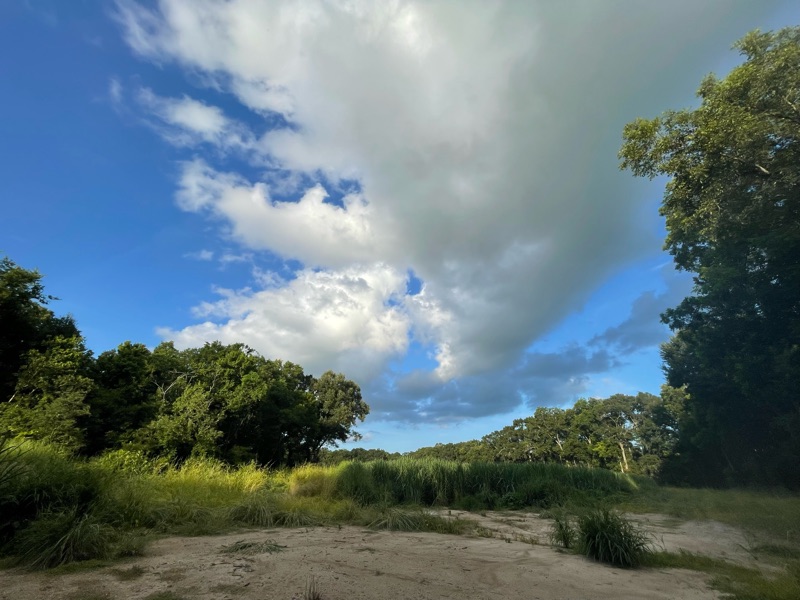
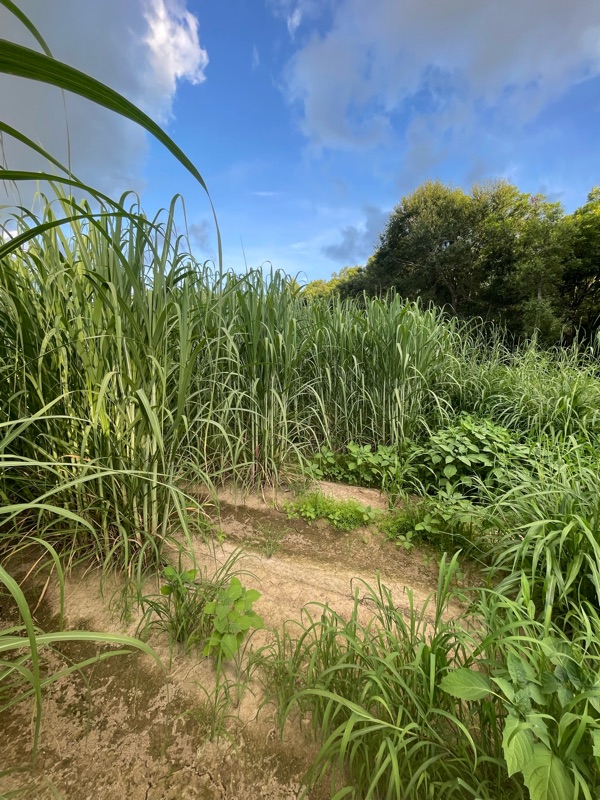
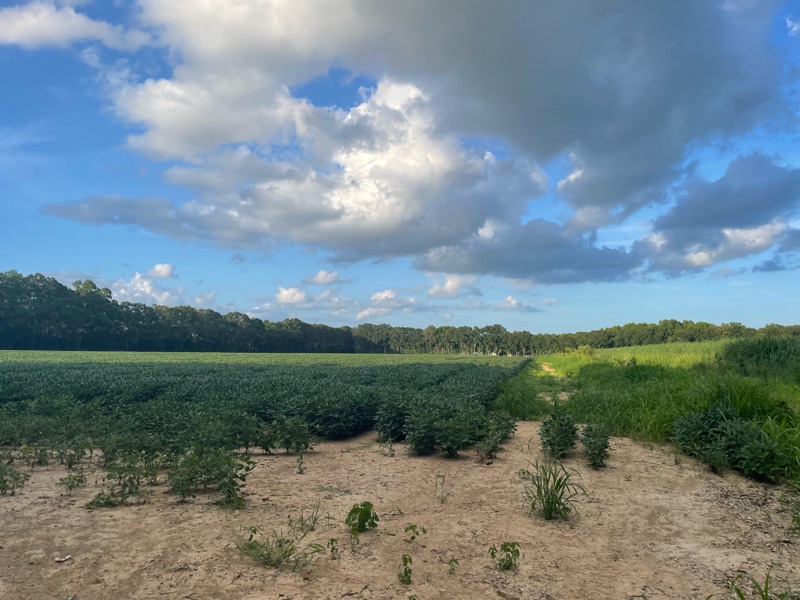
I watch the fields of Prairie des Femmes. They rotate soybean and sorghum most years, with a fallow year in there also. Some of the old timers will call the prairie "Prairie des Fermes" (Prairie of the Farms) because it was and still is an agricultural enclave. Some of the most persistent stories about this place revolve around the women (les femmes) who ran the farms (les fermes) and dairies while the men left to work or fight. However this anecdote is true in most places around the country in war times. The wars that the neighbors have given vary from the Revolutionary War, War of 1812, Civil War, WW1 or 2. Further research suggests that the memory of the prairie is older than American wars and that the wars in question were of the native Opelousas, Chitimacha or Atakapas tribes and may not have been traditional wars at all. Prairie des Femmes was said to be the peace zone between tribes. It is also said the men hid the women back here, or simply went hunting and never came back. Some say they were nomadic and just moved along the Teche while leaving this prairie as the base village for the women and children. It's even more interesting when one considers that we are on the western edge of the Teche Escarpment and tucked behind the ancient alluvial bluffs of Grand Coteau, where the Mississippi itself flowed. I also suspect that Grand Coteau was ceremonial grounds of some sort to the natives of this prairie.
This year there's a special atmosphere along the road because the close fields are in sugarcane and it creates the loveliest (for a prairie girl) vignettes while we search for broken ceramics in the late light of the summer afternoon.
Sale of Land of Michel Cormier
Michel Cormier was an Acadian who settled the Prairie des Femmes prior to 1773. Here is some information about him through Acadians in Gray.


Tuesday, June 23, 2026

Monday, June 22, 2026


.jpg)


Map at the Hive with Mr. Olan 1854
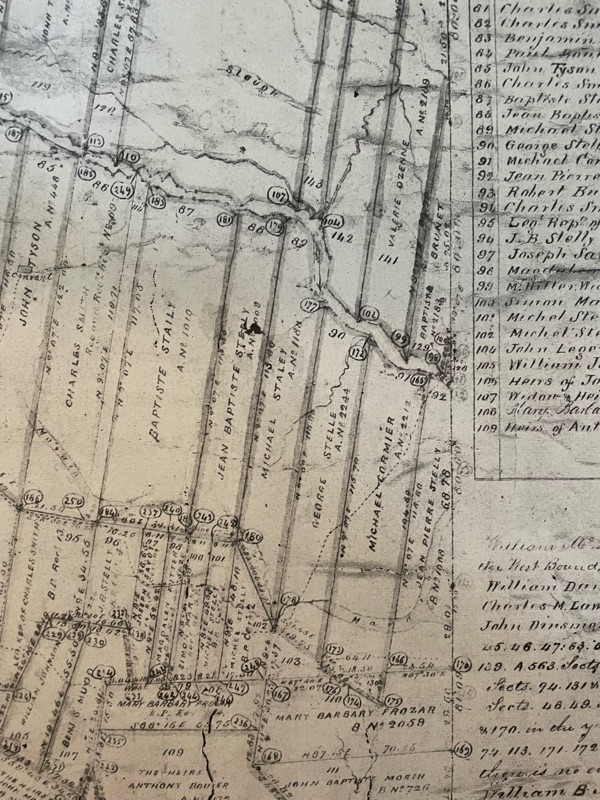
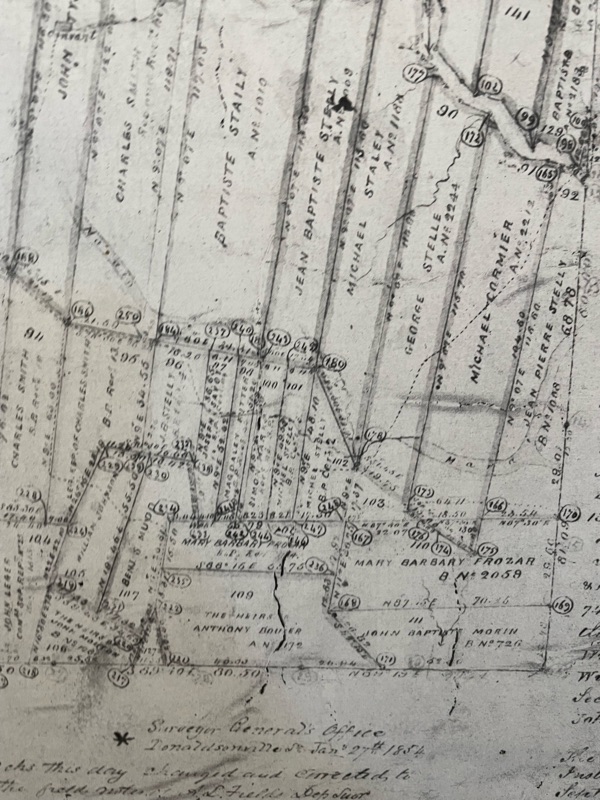
I spoke to Mr. Olan Thibodeaux at the old Hive as I was looking at this map leaning against the wall. He said it was his map, he had given it to the community coffee shop. I spent a lot of time looking at it and photographing it, and Mr. Olan mentioned that it was curious how many women were land owners in the Prairie des Femmes.
Sunday, June 21, 2026
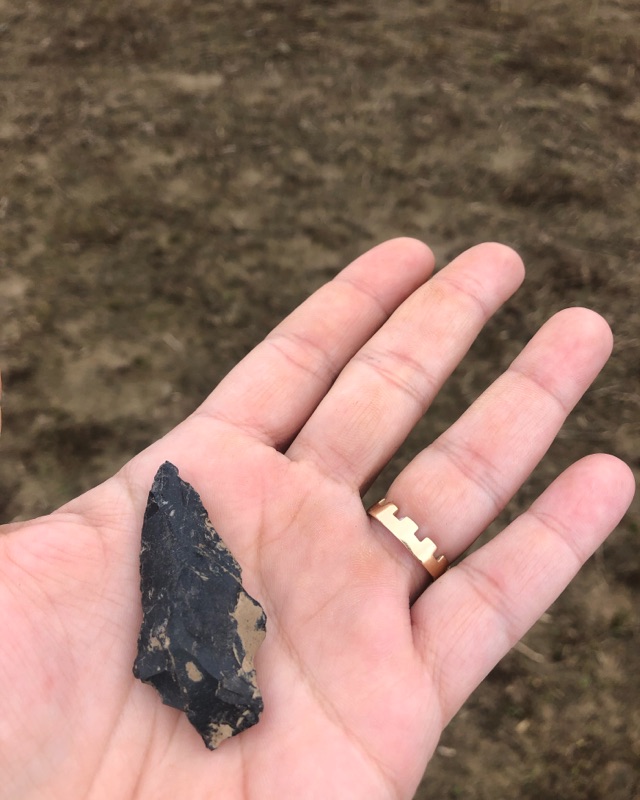
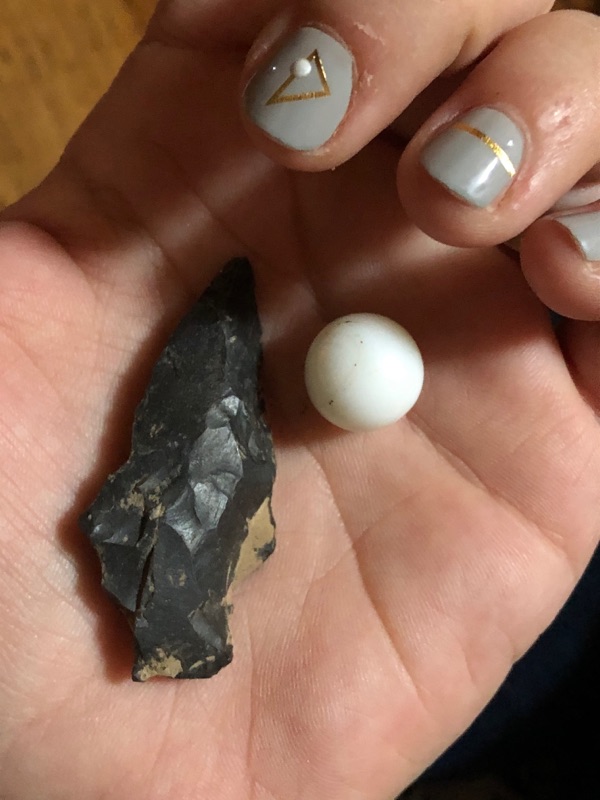
Black Spear Point- Olivier Site
I'd spent a decade or more walking what used to be a mound, now plowed a few times a year, called the Olivier Site. I am friends with the daughter of the owner of this field, which rotates soybeans and sorghum. I monitor this field. It was a prehistoric stone working place at the very edge of the Teche escarpment. The first artifacts I found there were scores of knapping shards, still very fine and sharp after all these years. They were multicolored, and since rock doesn't exist naturally in this prairie delta the imagination wonders to the origins of the white, blue, black, grey and red stone chips. Finding each one was thrilling for me.
I had been told that the neighbors found many artifacts in that field, but I never found more than the knapping pieces and maybe a small broken point or two. They are concentrated on the north edge of the rise of what used to be a great mound.
One day in 2019 I was walking the field as usual. I had never found a full artifact before. I found a white marble that reminded me of the full moon and some knapping and ceramics when all of a sudden I saw a piece of bone in the soil. I don't know what kind of mound was here before, but its likely it was burial. I picked up the piece of broken bone and just held it, out there in the field. It was leg or arm. In that moment I heard in my head, "You're going to find a point." I walked three steps and there was the black spear point on the dirt.

Tuesday, May 26, 2026
C.C. Robin
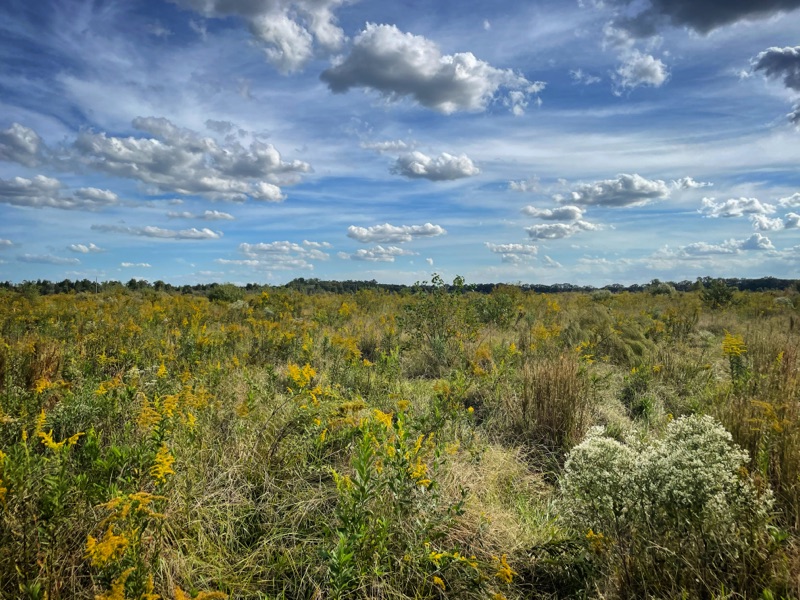
“Crossing the wide prairie, strewn with flowers, whose stems raise them to the height of the horse on which the traveler is riding, surprise follows surprise in this varied vegetation. One rides suddenly upon herds of cattle, who raise their haughty heads above the grass as one rapidly approaches.” (Robin (2000)).
Monday, May 25, 2026
Meche-Wilkes Mound

The Meche-Wilkes Mound, is located near Arnaudville on the periphery of the Atchafalaya Basin on the edge of the Pleistocene terrace. This site has been protected by the landowner and is relatively undisturbed. Gibson conducted excavations at the Meche-Wilkes Mound in 1990. The site contains deposits dating to the Poverty Point, Tchefuncte, Baytown, Plaquemine, and historic periods (Lousiana State Site Form).
The Anthropology department came across an historical discovery in '89, revealing some history of Acadiana. Archaeological excavations at Meche-Wilkes mound near Grand Coteau by USL archaeology students confirmed the earthen mounds were built by the Acadiana's native people during the first pre-Christian millennium. These mounds were used for cooking during the era. Lonnie Utley USL's L'Acadien 1989
Sunday, May 24, 2026
On the Olivier Site and Meche-Wilkes Mound

Jon L Gibson
The Ancient Mounds of Poverty Point Place


 CULTURAL RESOURCES SURVEY OF FOUR
DISPOSAL AREAS ALONG THE VERMILION RIVER
LAFAYETTE PARISH, LOUISIANA
CULTURAL RESOURCES SURVEY OF FOUR
DISPOSAL AREAS ALONG THE VERMILION RIVER
LAFAYETTE PARISH, LOUISIANA


Cultural Resources Survey of Four Disposal Areas Along the Vermilion River Lafayette Parish
Cultural Resources Survey of Four Disposal Areas
Along the Vermilion River Lafayette Parish:
US Army Corps of Engineers
"Despite its compact size, Beau Rivage (near the confluence of Bayou Tortue and Vermillion River) had large quantities of exotic rocks—thousands of pieces and possibly hundreds of kilograms. Exotics make up over a third of all lithic materials in the available collection (Gibson 1976a:Table 20). There are at least nine other sites within a 25km radius of Beau Rivage that have exotic materials—materials other than novaculite and quartz crystals, which are not really exclusive Poverty Point commodities (Gibson 1991b). The Olivier site (16SL12), near the junction of Coulee de Marks and Bayou Fusilier, is the most notable of these other sites (Gibson 1976a:38-39). But none of these sites comes close to matching Beau Rivage in absolute quantities, although Olivier might come close in terms of relative quantities. The point to be made here is that Beau Rivage is not an isolated component. For 25km above and below Beau Rivage along the Coteau Ridge and flanking Vermilion swamp are other presumably coeval sites bearing foreign lithic materials. We suspect Beau Rivage was the local supplier. But where did Beau Rivage get the rocks? In an earlier analysis, Gibson claimed that they came directly from the Poverty Point site, 280km to the north {Gibson 1979). Gibson thought they were first delivered to Poverty Point, where they were rendered into tool blanks before they were then shipped on to distant consumers, like Beau Rivage. Now, after more than a decade of recent excavation at Poverty Point have failed to find either the unaltered bulk materials or the primary chipping residue showing that preshaping actually took place at Poverty Point, we are not as certain. Initial shaping of tool blanks for trade now seems more likely to have been carried out at the rock outcrops or deposits themselves. Poverty Point still seems to be the most likely source of the blanks and nodules that got to Beau Rivage, but search for intervening distributors continues."
"...Several San Patrice points were found at Meche-Wilkes Mound, on Coulee de Marks near its junction with Bayou Fusilier"
"Additional Archaic components occur upstream and downstream from Lafayette. Downstream some eight kilometers below the Vermilion River gap is a cluster of sites (16VM7, 16VM17 and 16VM23) near the mouths of Anslem Coulee and Coulee He des Cannes. One of these (16VM23) produced several projectile points (including Evans, Ensor, Benton, and others), point fragments, drills and drill fragments, chipped adzes and gouges and fragments, boatstone fragments, and tubular and barrel-shaped stone beads (Gibson 1976a:Table 23, Figure 10). However, only a handful of flakes was recovered, totally insufficient to complement the number of finished tools on the site. The assemblage is unusual enough to lead us to suspect that it might be functionally specialized, perhaps even ceremonial. Upstream where the river parallels the Coteau Ridge are other Archaic components, and on the low Prairie des Femmes terrace, where flanked by Coulee de Marks between Grand Coteau and Arnaudville, is the oldest Archaic component known in the Vermilion locality. The Coulee de Marks site (16SL48) produced Early Archaic point types, Keithville and Cache River, as well as point fragments and preforms, small flake end scrapers, and chipping residue (Gibson 1990a:Table 24). There was substantial Archaic activity on or near the Vermilion River, and it seems to have spanned much of the long Archaic interval. But precisely when and what forms it took are unknown. We have only the most general perceptions of the interval, but they are sufficient to show that the locality continued to be a favorite spot for native groups. Having a long-standing sizeable population in a place with easy access to the interconnected waterways in the Lower Mississippi Valley was probably a prerequisite for entering into an era of commercial exchange, which characterized the ensuing period."

Back Field Habitation
This field where we settled over 20 years ago never seemed physically special but there was a presence here. It's a leached sweet potato field out in the center of the open prairie, near the oxbow woods as I called them. It was not on the bayou. There was no important earth works, inclines or mounds as there are in other places in the prairie. The neighbors have found buckets full of artifacts: spear points, grind stones and stone tools. I know of the three prehistoric sites in the prairie including the Meche-Wilkes Mound and the Olivier site, but they are a half mile away from here. For years I have walked looking at the ground and feeling the subtle undulations, but never suspecting that there had ever been anything here besides farmland and pasture.
I had found ceramics. Years ago we surmised they were spread to aerate the soil for farming. Maybe they were spread in a flood event. Either seemed plausible. Maybe more plausible than there being a homestead in the exact spot that we chose, ten acres back off a gravel road, near haphazardly and only because of its proximity to a lone cypress in the tree line.
I found delicate things in the earth though, the curl of a blue and white fleur de lis, doll arms and legs, pieces of plates, bricks, thick crocks and milk glass. Still, with our position back here I could hardly imagine there had been habitation so far off of the dirt road. There were no paths or racourcis that I knew of crossing the prairie. Still I got the message that there was memory back here, both recent and ancient. Then one day in the carrot patch I found a real rock in the shape of a perfect heart.
In the east yard we plowed some rows to plant coton jaune, native brown cotton. After it rained I would inspect the exposed ground along the rows. I found another stone, but this time it seemed to be a hand tool for grinding or hitting. There was a worn tip and slight indentions along the sides that fit my thumb and fingers perfectly. I marveled at its weight and ergonomic feeling in my hand.
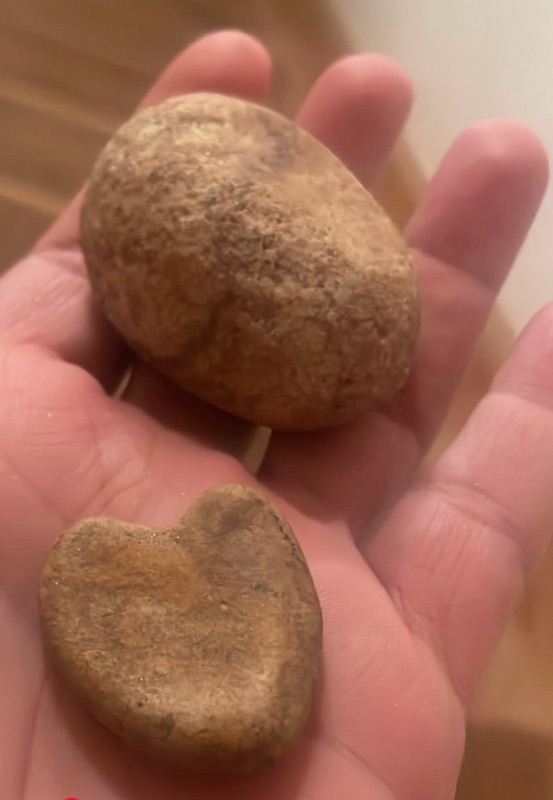
Sometimes when I walk the field, or even recently when I turned over a little dirt out there, I still find white ceramics and strange rocks, sometimes blue glass that looks knapped at the edges. The more I let the prairie grow, the more old plants appear that tell of use. The more I dig, the more is unearthed. I tell myself if there was a home place here it would have been in my east back field according to the evidence, but it still doesn't make sense. Not to mention how ironic it would be to have built in the same place. On the other hand, it does makes sense to me, because there is a tangible presence back here that is pleased to be remembered.
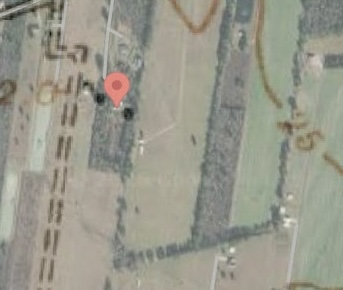
Recently I was going through some old topography maps online of the area and something caught my eye: a few black squares denoting domicile on the 1940 topographic map, far back in the prairie. Intrigued, I doubted it was far enough to be my field. But I used the overlay tool to match up the road and other landmarks with satellite maps, and discovered to my surprise that they were located at the end of my driveway, flanking both sides of my house, in the exact place where I find the ceramics in the backfield.
Saturday, May 23, 2026
The Dome of the Prairie
The prairie has a memory and it echos like a dome. I first felt it when I was alone out here at night, in a pull camper, waiting. I'd sit at the table, the light from the sliding glass door created a halo of illumination that terminated at the long grass, where I perceived its rustling as large animals passing in the darkness.
The pre-Katrina nights out here I was afraid of the wilderness of this place. It was the camp. I was never sure how near or far I was from civilization. I stayed quietly in the camper, barely wanting to alert the prairie of my presence. But the Tuesday New Orleans flooded, like so many others, I fled north and took refuge in the prairie like no other place before. The long gravel road was my moat, the orb of light in the field around the camper became my world, the safest place in south Louisiana.
We planted the prairie edge with a ring of thousands of native trees: sweet gum, live oak, cypress, persimmon, pecan, mulberry etc., keeping the center pasture open in different rotations. The trees created a little wood where we maintained a path, and formed a semi-circle around the perimeter of the property. The higher the edge trees grew, the more my prairie view was obstructed, but also the more the birdsong echoed within the dome of the prairie. I sat at the base of the cypress tree and imagined the life I would lead here. Somewhere, floating in the air above the prairie ground were the rooms of a castle-home not yet built, where I would live blissfully, conceive and become a mother, raise my children, where I would birth this very blog and all of the notions in it, where I would deny myself the world for the protection of the prairie.
I became one with this place, instinctually returning all fertility to her ground. It's here where my children's nombrils are buried, under a live oak in the western yard. I ate the flowers and fruits and roots produced here. I gathered and made medicines daily. I made perfume oils and sprays of the prairie flowers and balms with the pine sap. I caught rainwater and collected dew on resonant days. In the late afternoons in fall, I could hear a faint rumble, like thunder, of the Beau Chene drum line echoing in the dome. The prairie remembered drums.
I settled into the natural law of this land. We grew and lost both plants and animals without getting too sentimental. We allowed nature to rule, even a little wildly. Out of this natural kingdom many realms were born in me. We planted gardens but I never had a green thumb. It was the native plants that resonated because they were not reliant on me, except for my understanding of them and their environment and my dedication to their growth and protection. As time when on plants like honeysuckle, chassepareille, elderflower and blackberry crowded themselves through every crack of the fence, waving wildly to be noticed, to be made of use, and I listened.
There was an unassuming charm here at prairie, an enchanted, forgotten country east of Opelousas. It was in the juxtaposition of her beauty and humility, of how she is treated now, and the dignity in the story of who she was before. She remembered the millennia of seasons, and despite the modern agriculture, the cutting and poisoning and the forgetting of the old ways and the old languages, the plants remembered the cycles and seeds still remained in the ground who, despite the loss of so much rhizome, also remembered how to grow, especially after a prairie burn.
There was information in the silence and the space that I lived in, the movements of the plants and animals, the sunrises and sunsets, the position the moon rose at different phases adn in relation to the cypress tree. Sometimes when the prairie sky domed around the edge trees I could feel the different birdsongs that echoed within this protectorate. Slowly I learned that language, too.
 |
| My red ballet flats with prairie dirt in the camper, 2004 |
 |
| Decorations of dog fennel and a bottle of red liquid we found in the house, room party 2004 |
 |
| Me and Paul in the orb, 2005 |
 |
| The camper and the room, summer 2005 |
 |
| the pull camper |
Saturday, May 9, 2026
Things I found in the prairie after the rain
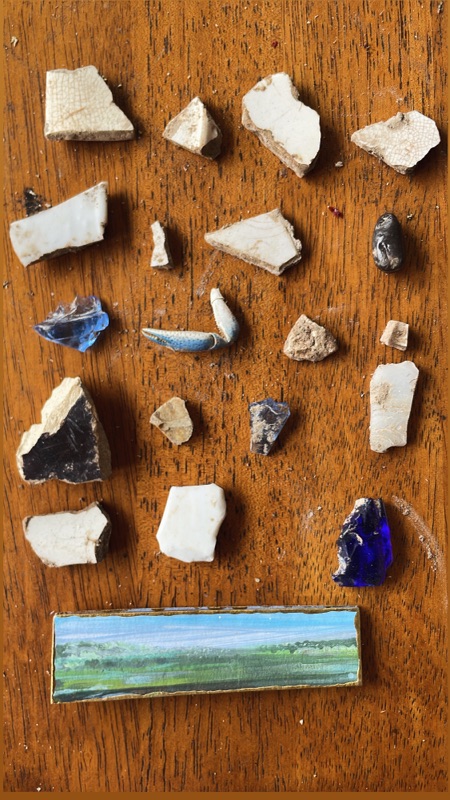
Various white and black glazed ceramic
Knapped blue glass
Blue crawfish claw
Heavy polished black stone
Saturday, September 7, 2024
Our Lady is not Bound by Means: The Borders of Prairie des Femmes
Prairie des Femmes is a small prairie found near the border of the Ishak and Oplousas territory, one of the earliest places found and settled within the colonial Poste des Opelousas. My research of this place has spanned 20 years and continues to grow in profondeur. Prairie des Femmes is a translation of the original Ishak, possibly Choctaw name. In keeping with this momentum, my goal is to find the indigenous name for this land. The possible approximation provided to me by Attakapas-Ishak scholar and poet Jeffery Darensbourg is Lōksh Keshíke, Prairie Women, in Ishak, but we can not know if the French that remains is a true translation of what was originally here, or their interpretation of what they found.
Our Lady is not bound by means but if we must give boundaries she is found at the triangulation of the villages of Grand Coteau to the west, Arnaudville to the east, and Leonville to the north. The historic community of Frozard (Olivier Plantation) is found within the southern boundary of Prairie des Femmes, at an intersection of the old native path we now call Hwy. 93 and Meche-Frozard roads, and extends south to the junction of Bayous Fuselier and Bourbeux. I often say that if Prairie des Femmes had a city or crossroads, it would be Frozard.
PDF is water-bound by an oxbow swamp to the north, Bayou Fuselier to the southeast, Bayou Bourbeaux to the north and west. There are at least two bridges in the interior prairie, one over the Bourbeaux at Hickory and one over La Coulee des Marks known as Marks Bridge at Jules LaGrange.
She is a prairillon among other larger prairies of Louisiana. To the north, in the back, and across the oxbow swamp is the native-Creole enclave of Prairie Laurent, also known as la Côte/l'anse des Mulates. To the northwest, la Prairie des Coteaux where Cypress Valley can be seen east of I49 at Opelousas. To the west of Prairie des Femmes is la Prairie des Grands Coteaux, and to the east, la Pointe Claire and la Prairie des Gros Chevreuils which touches the western levees of the Atchafalaya basin and encompasses Pecaniere. To the south is la Prairie Basse, aka Prairie de Manne (colonially Prairie de la Grosse Patate), with the greater Prairie Carencro further south.
Prairie des Femmes exists in an area congruent with the boundaries of the Attakapas-Ishak tribal lands and the Opelousas tribal lands and there is much evidence of earthworks, mounds, pottery, grindstones and spear points found here. There are pre-historic mound sites that connect to Poverty Point. Despite years of modern agriculture on the prairie, these features, as well as land-memory, persist and continue to reveal themselves.
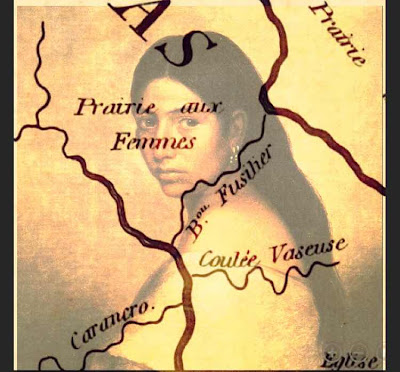
Tuesday, September 3, 2024
Prairie des Femmes Origin Stories
Prairie des Femmes
Coming to the Prairie and Staying
When I arrived here in 2004 my neighbors called the area Leonville or Anaudville, for the bayou villages to the extreme north and east of the prairie, respectively. There was no marker, no sign and no online presence of the pre-colonial Prairie des Femmes, save for topographical maps where she was marked at Coulee des Marks bridge, and two inquisitive articles published in the Teche News by Mr. Floyd Knott. If I am completely honest, there was also a wood routed sign that said Prairie des Femmes on a neighbor's chicken coop up by the Bayou Bourbeux that I spied through the trees.
The romance of the name seemed to me incongruent with the general knowledge of her existence. I was from another village, called la Ville Platte further to the north in Evangeline Parish. Around la Ville we had many other lieu-dits, les petits places, where we visited and that were part of the common vernacular of life. There was Chataignier, of course, and halfway there, la Pointe Bleue and L'anse Aux Pailles. We frequented Faubourg, Tate Cove, L'anse des Belaire, Vidrine, Redell, and L'anse Grise beyond. I was familiar with these places, yet just 20 minutes from my hometown, I had moved to this women's place whose history and terrain felt remote and largely unexplored.
Louisiana French connected me more closely to my state, her French and native memory and my place within it all. I began to gather maps, records and historical research as well as personal stories about how the prairie was named: her origin stories. It was clear that these are all native lands and la Prairie des Femmes is a reminder. The neighbors reported the prairie was a place where women and children were found living when the men left for one reason or another. If I asked, they pointed me to the Civil War as origin of the mens' absence, but the records I found suggested that the prairie had a longer memory.
One local said he believed that the girls outnumbered the boys at the house dances, and that the Stelly, Marks and Quebedaux families produced them. Another story says that in Louisiana's historic flood of 1927 woman and children were sent here from neighboring communities because of its relative safety. (The prairie is at some elevation, but I am still not sure what parts of her flooded in '27) Another tale sites the area as a place where the widows of the soldiers of the Civil War settled to live the remainder of their lives in peace. Some say the women of the area refuged back here when the skirmishes along the bayou Bourbeaux, at Grand Coteau and Chretien Point made it unsafe for the women and children in town. Some reported that the women were left here to farm while the men fought for the Civil War, WW1 or WW2. Some locals even pronounce it "prairie des fermes" and will connect the name to the women farming, or the fact that there are still many agricultural fields here. Another neighbor gave me the rough coordinates of a "fort" that existed here for the protection of the women.
The most likely story of the origin of the name Prairie des Femmes is the native one, of course. The prairie is a pre-colonial, native place, located at the historical boundary of the Attakapas-Iskak and Opelousas tribal lands. It is named for bands of Ishak and earlier Tchefuncte people who used the prairie was a backwater refuge for their women and children away from the major rivers and bayous of the time. Prairie des/aux Femmes appears on detailed maps of the region as early as 1806. Because of the prairie's central and borderland location, there was much native traffic and infrastructure here.
Legend has that the area was a high land, a safe zone near the bayous where women lived together while the men hunted or warred. There are a few versions of this story. One is that the male natives inhabiting the prairie moved after a hunt, as was custom. A few of the women stayed at the camp, being too comfortable to move. Another version says that the prairie was used in ancient times as an off-river refuge for the women that protected them until the men came back. The men were always leaving for war or hunting in the stories. Another says that the male hunters, or bears, went on a hunt leaving their wives on the prairie. The women left there were discovered by the French Creoles and Acadians (Michel Cormier) who settled the area and called it la Prairie aux Femmes. (In Louisiana vernacular the contraction des and aux ((of/to/at the)) are both used when showing possession, aux being older. I have found both des and aux on maps of the prairie) I am often curious if the name is a direct translation of the indigenous name for the place, and if so what the old name was. One of my neighbors had his explanation, offering "that's an old name, yeah." After 20 years of research, this seems to be the most accurate detail of all.
Thursday, May 30, 2024
Subscribe to:
Posts
(
Atom
)