
Showing posts with label chassepareille. Show all posts
Showing posts with label chassepareille. Show all posts
Wednesday, September 23, 2026

Monday, September 21, 2026
Fruits of Automne
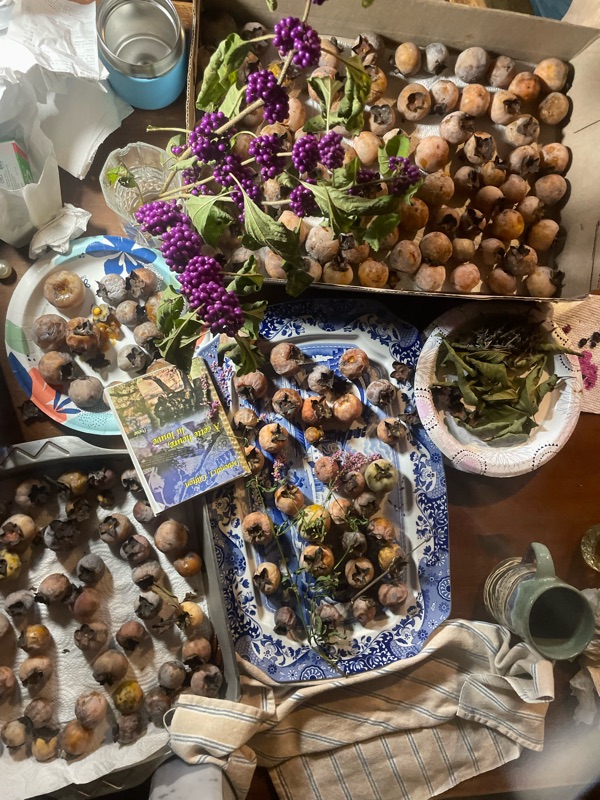
Herbals I am processing a home in September:
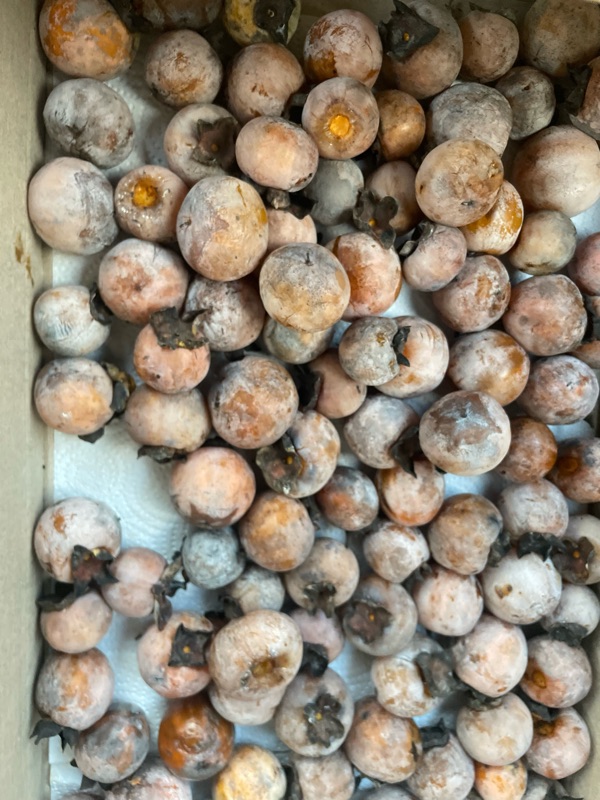
Drying herbe cabri, elderberries, eldeflowers, chassepareille berries, chou gras berries, plaquemines and plaquemine seeds, loofa and loofa seeds, chassepareille leaves in alcohol for bug repellant, perilla in alcohol turned it bright green, an enamel bowl of jobs tears, vineraire
Sunday, September 20, 2026
Qiū Sī of a Louisiana Autumn
秋思 d'un Automne Cadien
The contents of a box- dried maypops
La lumiere du soleil tourne comme la verge d'or
Indian heliotrope, tournesol du marais
The wormseed chronicles on Jules LaGrange
The smell of dried vineraire in the prairie
A coyote under the plaquemine tree
Piquante bleue dans le platin
Poke berries, elder berries, socos, pepper berries, chassepareille
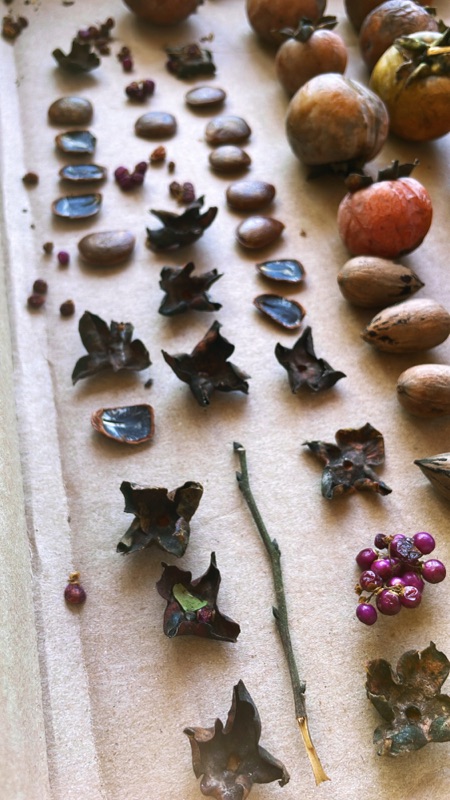
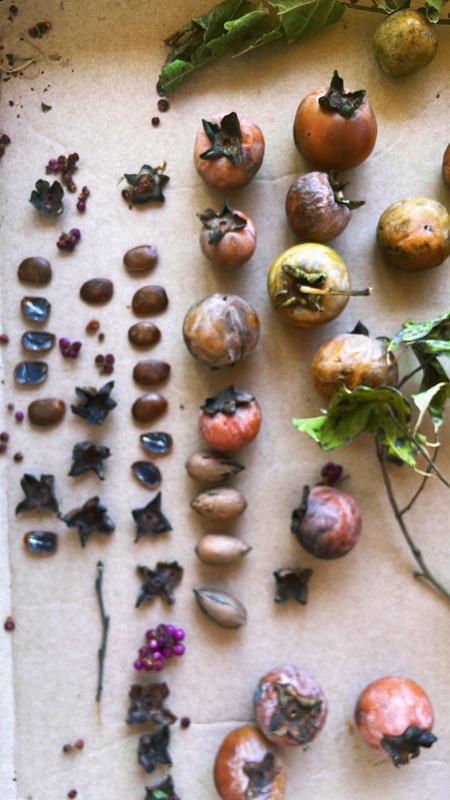
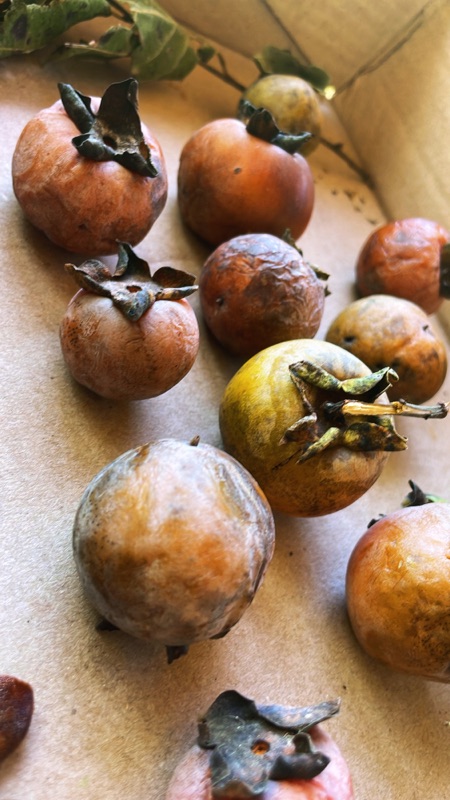
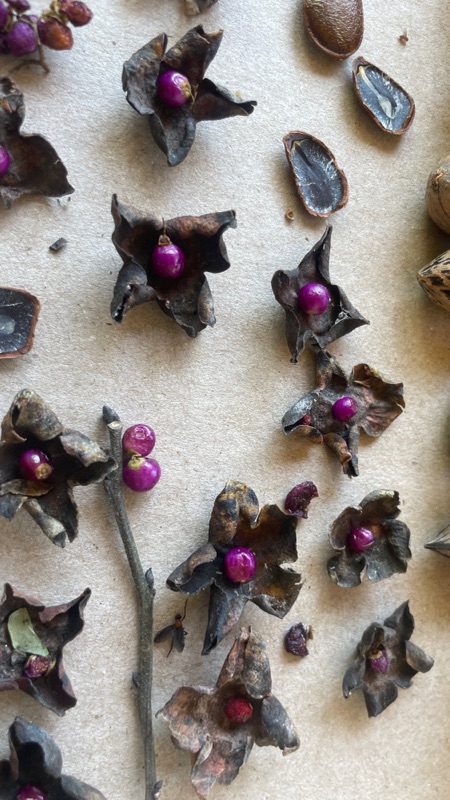
Persimmon seeds opened like books to fortell the winter
Lizard's tail root in water
L'eau de chassepareille
Les oranges du bois
Wax myrtle fruits
Gateau sirop
Tea cakes and sweet dough
Pecans and hickory nuts
The first spider lillies, curage rose, pea vines, orange trumpet vine, yellow loofa flowers
Patates douces de Pecaniere
Fils de la vierge dans l'air
Far off smoke of cane field fires
Cicada wings, a luna moth under the sweet gum tree
Copal resin and pine sap
Herbe cabri from the Jesuit pasture
Musk melon vines
Ground Cherry
Possom grapes, soco
The smell of cut hay on the coteau
Saturday, September 19, 2026
Les plaquemines de la Prairie des Femmes
At the old convent on the hill I gather chassepareille from the woods and soak it in cold water. I drink this infusion with spherical ice while the girls and I snack on plaquemines. I tell them that the least attractive fruits taste the best and let the pretty, perfect ones pucker our mouths. We cut the seeds on the seam and open them like books to foretell the winter weather. I explain to the girls that learning Louisiana French is as much about the fruits of the land as it is about the language.
Saturday, September 12, 2026
Medicinal Plants on the Coteau
In the flat coastal plain of south Louisiana high ground is sacred. Our indigenous ancestors were mound builders. Settlements appeared along chenières, or ridges of oaks, and local folklore says that even one old live oak tree is a good sign that the surrounding land won't flood. In times of severe hurricane, one survival skill was to lash one's self to the mid-branches of the live oak with grape and muscadine vines to ride it out. Those that did this usually survived.
In this near sea-level prairie, it is known that the hill of Grand Coteau is sacred, high holy ground. It was this way long before the land was claimed by colonial-era settlers like Sieur Smith, the Religious of the Sacred Heart and the Jesuits. Much is made about the Catholic presence of the land, because of the early institutions such as nearby Saint Charles College, Saint Ignatius School and the Schools of the Sacred Heart, where a miracle happened when Mary Wilson was healed by the intercession of Saint John Berchmans. But a local legend is that it was the Grand Coteau where indigenous men, notably the Opelousa and Ishak, would go to "fight with honor". The validity of this and what it means, whether battle, ceremony, hunting or even competitive ball game is still mysterious. This story seems to weave in with lore of the Prairie des Femmes, just across the bayou and east of the Academy for girls, being a place where the women stayed when the men left to fight or hunt.
Grand Coteau is on the Coteau or Coteau Ridge. It is the ancient bluffs of the Mississippi River when it flowed west, also called the Teche escarpment. The land that holds the ancient convent and Academy of the Sacred Heart has been called "la prairie des coteaux". The Academy is a pastoral landscape reminiscent of old France and colonial Louisiana, containing multiple live oak and pine alleys, pecan alleys, formal gardens and orchards, open rolling prairie with horse and cow pastures. The four-story Academy is surrounded galleries and a garconière, formal gardens, rolling pastures and then beyond, the Secret Hart and the bois vièrge, a forest primeval that has never been disturbed throughout the centuries. In the formal gardens one notices the early varieties of roses, crepe myrtles, camelias, azaleas, sweet olive and gardenias. There are white, red and pink roses and azaleas, as well as pineapple guava bushes in the center whose flowers taste like Fruit Loops. L'absinthe grows in the pecanères which are plentiful and produce sweet full pecans in the fall. The sheer age of some of these bushes and trees ensures high yield of their medicines and fruits. I often think that the sisters and enslaved people who planted and developed these gardens, they who indeed survived times of famine, flood and war back here, seem to have taken seriously their choices of edibles and ornamentals.
Over the seasons of working at the Academy and as my eyes adjusted to the landscape, they also zoomed in on the native and medicinal plants that pop up at the fringes and in the lands that surround the gardens. This seemed to be a deeper indicator of native land stewardship, a sign of ancient wild habitation still amid the efforts to tame the land. Chou-gras (poke salat) was shooting up at the base of the pines of the alley, in Saint Francis Patio and along the Chapel wall. The woods to the east of the Academy were full of poke as well as nettle, resinous pine, violets and muscadine. In the tree lines are oak, pecan, copal, cherry, magnolia, chassepareille, cherry laurel, hickory, tulip tree, bitter orange and palmetto. I collect Spanish moss, perilla, chickweed, violet flower, root and leaf, white clover, green resurrection fern, and orange chanterelle mushrooms from the oak alley. I find fresh herbe cabri every fall along the ditches of the Jesuit pasture. Their leaves can be used for tea and the young seed eaten as a melon flavored snack.
The nettles in the woods I gather bare handed in the spring and dry the leaves for tea. I'll use the formic acid on the leaves for muscle and mood therapy and the seeds for nutrition. From the poke I gather berries for dye, the leaves for spinach and the extremely toxic and dangerous root for inflammation therapy. The bitter orange fruit we gather and use for Christmas decoration with cloves for pomanders. I gather white flowers of the sweet olive, orange, and gardenia that fill the gardens at different intervals to make enfleurage oils. The girls and I make accessories such as flower crowns, necklaces and crafts (like Marie Antoinette's bouffant) with the fallen roses, azaleas, camelias and wildflowers of the garden. I harvest baume from the native plant garden as a spice and perfume, chassepareille leaves for insect repellant and cherry from the woods for bounce. I harvest pine sap daily from the trees of the pine alley, sometimes they appear as resinous ambers that fall from above, and other times in the clearest tears of sap that are produced when the grounds crew hit the exposed roots with lawn mowers while manicuring the gardens. I walk the pine alley in the fog of the morning collecting miniature domes of sap from roots like dewfall.
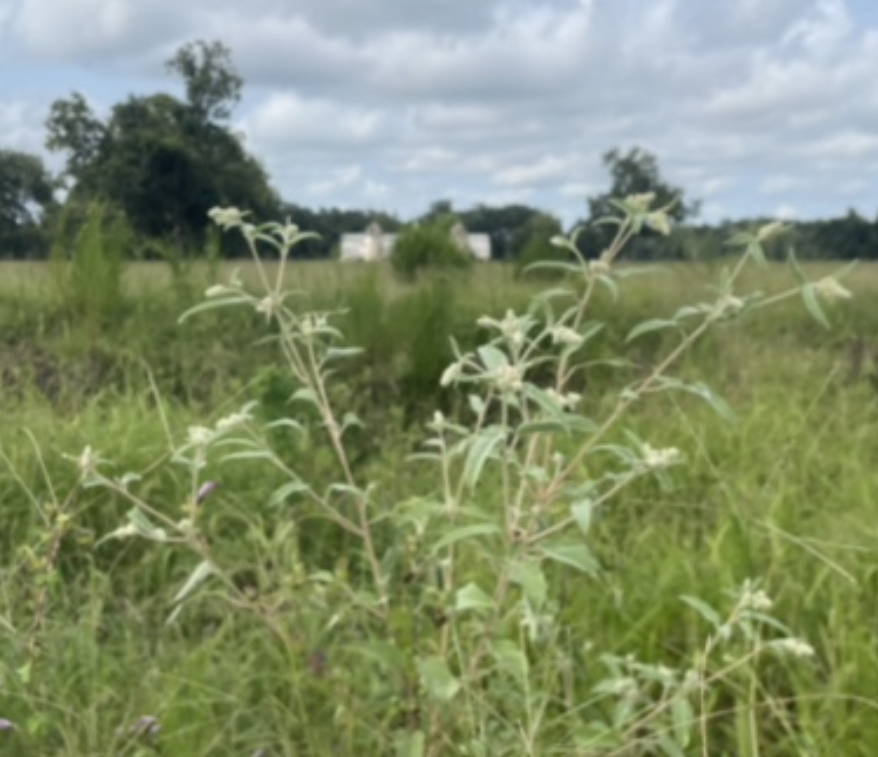 |
| l'herbe cabri |
Saturday, May 23, 2026
The Dome of the Prairie
The prairie has a memory and it echos like a dome. I first felt it when I was alone out here at night, in a pull camper, waiting. I'd sit at the table, the light from the sliding glass door created a halo of illumination that terminated at the long grass, where I perceived its rustling as large animals passing in the darkness.
The pre-Katrina nights out here I was afraid of the wilderness of this place. It was the camp. I was never sure how near or far I was from civilization. I stayed quietly in the camper, barely wanting to alert the prairie of my presence. But the Tuesday New Orleans flooded, like so many others, I fled north and took refuge in the prairie like no other place before. The long gravel road was my moat, the orb of light in the field around the camper became my world, the safest place in south Louisiana.
We planted the prairie edge with a ring of thousands of native trees: sweet gum, live oak, cypress, persimmon, pecan, mulberry etc., keeping the center pasture open in different rotations. The trees created a little wood where we maintained a path, and formed a semi-circle around the perimeter of the property. The higher the edge trees grew, the more my prairie view was obstructed, but also the more the birdsong echoed within the dome of the prairie. I sat at the base of the cypress tree and imagined the life I would lead here. Somewhere, floating in the air above the prairie ground were the rooms of a castle-home not yet built, where I would live blissfully, conceive and become a mother, raise my children, where I would birth this very blog and all of the notions in it, where I would deny myself the world for the protection of the prairie.
I became one with this place, instinctually returning all fertility to her ground. It's here where my children's nombrils are buried, under a live oak in the western yard. I ate the flowers and fruits and roots produced here. I gathered and made medicines daily. I made perfume oils and sprays of the prairie flowers and balms with the pine sap. I caught rainwater and collected dew on resonant days. In the late afternoons in fall, I could hear a faint rumble, like thunder, of the Beau Chene drum line echoing in the dome. The prairie remembered drums.
I settled into the natural law of this land. We grew and lost both plants and animals without getting too sentimental. We allowed nature to rule, even a little wildly. Out of this natural kingdom many realms were born in me. We planted gardens but I never had a green thumb. It was the native plants that resonated because they were not reliant on me, except for my understanding of them and their environment and my dedication to their growth and protection. As time when on plants like honeysuckle, chassepareille, elderflower and blackberry crowded themselves through every crack of the fence, waving wildly to be noticed, to be made of use, and I listened.
There was an unassuming charm here at prairie, an enchanted, forgotten country east of Opelousas. It was in the juxtaposition of her beauty and humility, of how she is treated now, and the dignity in the story of who she was before. She remembered the millennia of seasons, and despite the modern agriculture, the cutting and poisoning and the forgetting of the old ways and the old languages, the plants remembered the cycles and seeds still remained in the ground who, despite the loss of so much rhizome, also remembered how to grow, especially after a prairie burn.
There was information in the silence and the space that I lived in, the movements of the plants and animals, the sunrises and sunsets, the position the moon rose at different phases adn in relation to the cypress tree. Sometimes when the prairie sky domed around the edge trees I could feel the different birdsongs that echoed within this protectorate. Slowly I learned that language, too.
 |
| My red ballet flats with prairie dirt in the camper, 2004 |
 |
| Decorations of dog fennel and a bottle of red liquid we found in the house, room party 2004 |
 |
| Me and Paul in the orb, 2005 |
 |
| The camper and the room, summer 2005 |
 |
| the pull camper |
Saturday, September 28, 2024
Les signes de l'automne
La vinéraire blanchit
C'est l'avant automne
l'Assomption arrive
Annoncant le temps preis
De ramasser ma sasafron
La lumière change
Gateau sirop, plaquemines oranges
La roulaison dans Prairie Laurent
Oxblood et vermillion
Damballah Le Grand Esprit
La Toussaint of memory
Umbrelles of elder in the sureau trees
A carencro feather, Bon Dieu te bénit
Je bois l'eau de chassepareille
The sides of the coteau are cut for hay
He likes a thin gumbo, no filé
Monday, May 27, 2024
Vinéraire Part 6: A Vulnerary Plant
In 2022 I began having coffee meet ups with three of my mentors to discuss a project on native plants they wanted to involve me in. Amanda Lafleur, Bill Fontenot and Dr. Ray Brassieur and I met a few times in the fall of 2022. At the meetings I presented them each with a sprig of the sweet everlasting. I left these meetings with a life changing sense of dedication and dignity for the work I was doing.
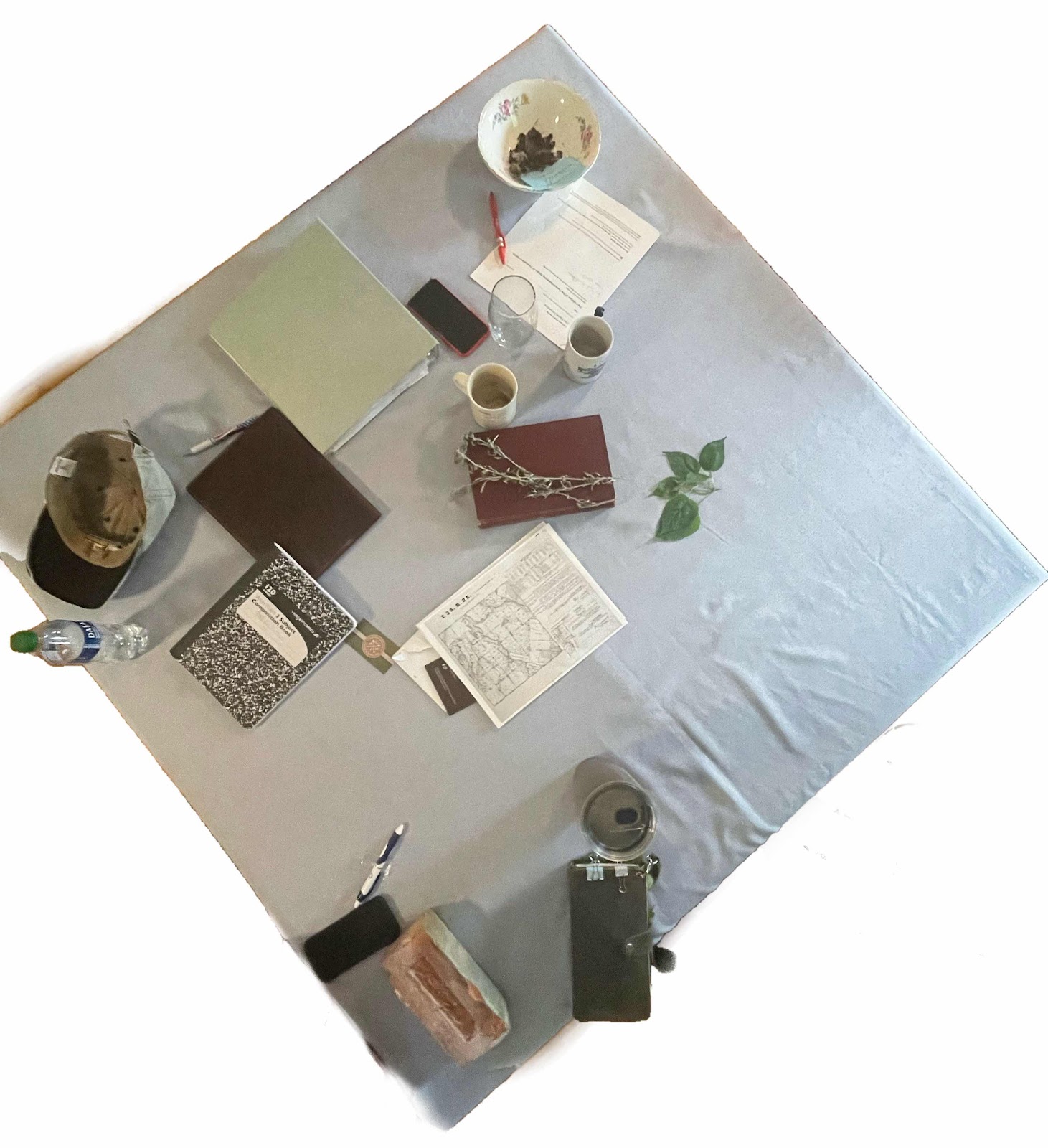
In December 2022 I attended a prairie society function at NuNu’s in Arnaudville where I ran into my Frozard neighbor Dr. Allain whose photographs on the USGS survey I had used for months. I knew at this time that this plant was rare in my experience, but these prairie biologists were familiar with it. I gave Dr. Allain a sprig of flowers and he was able to sprout seed. He said the rosette was purple cudweed, which was common in our area. I knew there were differences between the purple cudweed and the sweet everlasting in my own pasture, and taking all opinions in for consideration, continued observing them.
At a follow up coffee with Dr. Brassieur I presented him with a gallon ziplock bag of the vinéraire. He was full of insight and offered the origin of the name:
The word vinéraire conjures up ideas of a plant that is venerated, and so this is true, but the word has more to do with vulnerability than adoration. He explained that vinéraire, as we say, was a corruption of vulnéraire, a vulnerary (all purpose healing) plant. "Corruption" isn't really a nice word and I don't ascribe to the idea that Louisiana French has been degraded in any way, rather, it has been enriched. The name represents a change to the French in Louisiana because of factors such language influences and the predominantly oral aspect of the language. For example, I worked with American Beauty Berry, in French sassepareille, but also in Louisiana creole chassepareille and sometimes in Point Blue, bouilli sauvage. Would I call chassepareille a corruption? No, I'd call it poetry.
According to vocabulary.com:
The old-fashioned word vulnerary can be used as a noun or an adjective to describe plants that are used to heal wounds or treat illnesses. Calendula flowers are sometimes used as a vulnerary…Vulnerary shares a root with vulnerable, the Latin vulnus, or "wound."
Dr. Brassieur also told me of emails he’d received from native women down the bayou like Marlene Toups and Therese Dardar who were looking to Louisiana ethnobotanists and horticulturalists for the vinéraire of their memory. Some said they had not seen the plant in forty years. They used to smell it in the savanne, like syrup, and their daddies would bring it back from the rabbit hunts. Dr. Brassieur remarked that smelling it in the field was the same way I found it, plus my field is full of rabbits.
I left that vinéraire-coffee with the good professor with a clear mission: to grow this plant out and return it to anyone who wanted it, especially the native women and tribes who had lost it. I knew this plant existed up north, but I had no other sightings of it here in Prairie des Femmes in all of my years tromping this countryside and scanning the roadsides. Even the fields bordering my field are strangely barren of it, or much diversity at all. I felt confident that whatever strain of this plant that was surviving here was somewhat tolerant of our micro-climate, and deserved after all these years to be venerated.

Part 7: Big Bill as the Voice of God
Part 9: The Prairie has a memory.
Thursday, May 1, 2014
Sunday, September 9, 2012
Uses of the French Mulberry
I love the early fall in Louisiana because French mulberries (beauty berries) are plentiful in the woods and along bayous around here, especially at our family camp, La Roue qui Pend (The Hanging Wheel) on the banks of the Bayou Vermilion, where I gathered three grocery bags full yesterday.
 |
| I need three Winn-Dixie grocery bags full of French mulberries RIGHT NOW to the VIP! |
A few years ago, I heard that you could soak the berries in water in the ice box for a "refreshing drink". So I did that, and it is a nice and hebal drink. I had also read somewhere that people put the leaves under their hats to
keep the maringouins away, so I tried crushing the leaves up and rubbing
them on. That works well in a pinch. Then I began to make homemade insect repellant with the leaves and berries by soaking them in vodka for a month or two. I also add some crushed citronella leaves and maybe a few drops of lavender or lemongrass oil.

I have been harvesting these berries this year and drying them in the window, giving them out to friends. I add them to cereal, or eat them alone. I read that the berries or a tea from the root or bark is good for stomach upset, and we use the dried berries like that, too.
 |
| Drying French mulberries |
When picking the berries to dry them I wondered if they could be used in jellies. Don't you know, the next day I saw an article about a family that makes jelly and insect repellant from them.

Beauty Berry Jelly
(approximate, fond culotte style)
8 cups French mulberries, cover with water, with a little extra. (5 cups?)
Boil for 20 minutes until they lose their color.
Remove berries, compost.
Add one pack of Sure-Gel( two?), five cups of sugar, and half cup of lemon juice to the infusion liquid.
Boil until it forms a foam on the top, skim for clarity. Check the beautiful color!
Strain with cheesecloth (not necessary, but nice to get the punaises and spiders that may be still floating...)
Pour in sterilized jars and follow canning instructions.
Follow these Fond Culotte methods to a T, or your jelly may not "jel", like mine! I think I put too much water and not enough lemon juice... so I may have gotten a bunch of perfectly sealed French mulberry syrup...
In fact, forget the fond culotte method, I would just click here.
 |
| French mulberry jelly |
La Roue Qui Pend
 |
| picking French mulberries at the camp |
 |
| Bayou Vermilion? check mark |
 |
| French Mulberry patch at the camp. |


Subscribe to:
Posts
(
Atom
)