

Monday, June 2, 2014

Saturday, May 24, 2014
More Origin Stories
I ran into my neighbor at the New Silver Slipper (Cajun Hibachi!) and asked her about the name Prairie des Femmes. She said that her mother or grandmother said it was because of the Indians. When the Indians would go off to fight and were killed, their widows came here to live together.


Friday, May 23, 2014


Monday, May 19, 2014
Roses via the Tasse Cafe
A Rose
Tu dis en français une rose!
Rose of Sharon: un Althea
A dwarf rose, ça appelle ça un cinq-sous!
A moss rose, une mousse fleur, ça dit.
Cherokee rose, on est familieux avec ça
les grandes talles d'éronces, les cherokis!
Around Grand Prairie ça appellait ça
la Manche des Cherokis
because there were lot of those roses that were used as a fence because it was so thick the cattle couldn't pass through.
Nous-autres on restait
Là àyou Cameron est asteur,
et le chemin de l'Anse de Tate jusqu'à Cameron
Ça appellait ça la manche des rosiers
C'était les grosses fleurs blanches
les éronces épais, oh yes!
Les fleurs était blanches...
Ça me suprenais pas s'il ya toujours quelque pieds de ça là dedans c't manche là, mais asteur c'est un chemin! C'est tout changé asteur.
Asteur c'est pu un lane!
Ça appellait ça Brésil dans ses temps là.
Ça change, tout!
Asteur y'a le chemin Theophile.
Mais la Manche des Rosiers té après le chemin Theophile.
Écoute, les cherokis!? You can still find some on the railroad tracks.

Tu dis en français une rose!
Rose of Sharon: un Althea
A dwarf rose, ça appelle ça un cinq-sous!
A moss rose, une mousse fleur, ça dit.
Cherokee rose, on est familieux avec ça
les grandes talles d'éronces, les cherokis!
Around Grand Prairie ça appellait ça
la Manche des Cherokis
because there were lot of those roses that were used as a fence because it was so thick the cattle couldn't pass through.
Nous-autres on restait
Là àyou Cameron est asteur,
et le chemin de l'Anse de Tate jusqu'à Cameron
Ça appellait ça la manche des rosiers
C'était les grosses fleurs blanches
les éronces épais, oh yes!
Les fleurs était blanches...
Ça me suprenais pas s'il ya toujours quelque pieds de ça là dedans c't manche là, mais asteur c'est un chemin! C'est tout changé asteur.
Asteur c'est pu un lane!
Ça appellait ça Brésil dans ses temps là.
Ça change, tout!
Asteur y'a le chemin Theophile.
Mais la Manche des Rosiers té après le chemin Theophile.
Écoute, les cherokis!? You can still find some on the railroad tracks.
Wednesday, May 14, 2014
Dans la Bible ça dit...
Dans la Bible ça dit, le Dieu dit: Tourne à moi, écoutez les messages de Dieu et pis repentez! Changez votre vie et priez et j'vas venir à le secours de votre pays et votre monde. Ça c'est-- on a besoin de ça!
Sunday, May 11, 2014


Wednesday, May 7, 2014
Intro

I grew up Catholic in South Louisiana where shrines dedicated to the Blessed Mother are so common in homes and in yards that they go nearly unremarked. Yard grottos seemed as part of the landscape as the rosebushes and bird baths, hand pumps, and Victorian gazing balls that Cajuns and Creoles decorate with. Like most Catholic women, I inherited and cultivated a venation for the Blessed Mother, I saw the statues, but it was such a normal and quiet thing that it was unquestioned by me until I grew up, learned about myself, and looked around the prairie highways of my homeland with new eyes.
When I was twenty one I went to Church Point, Nova Scotia to learn French at the Université Sainte Anne where I was immersed in the language of my French and Acadian ancestors on the the very land where they lived four hundred years ago. I realized that our modern Acadian cousins shared more than last names and French blood with us, but that they were aware of our history in a different way than I had been growing up in South Louisiana. They were proud of their language and especially of their flag, the French tri-color, with one addition: a brilliant yellow five-pointed star in the field of blue in the top left corner that I was told represented the Maris Stella, Mary, Star of the Sea, Protectoress of the Acadians who had shepherded them on their sea voyage across the Atlantic from France. While on excursion to an old Acadian graveyard, I entered a small chapel that had an altar and large statue of Our Lady of the Assumption inside. She crushed the serpent underfoot. She reminded me of home and family in a new and profound way. Back in Louisiana, the more French I learned, the more sensitive I was to our uniqueness and also our interconnectedness with other French speaking, Catholic cultures around the world. I seemed to hear French everywhere, and the grottos to the Virgin Mary became a physical representation for me of the beauty, humility and faith of our culture. As I documented more local history and French, I thought someone should also document the grottos, but I never thought that person would be me.
I was married after the Storms of 2005 and moved to the country of Saint Landy Parish, to an unincorporated area called la Prairie des Femmes, or Prairie of the Women. I struggled to teach French at the local high school, run a country household, and be the wife a mother I really wanted to be. My husband was supportive and encouraged me to stop teaching and stay at home with our children, and we made the necessary sacrifices. Needing an outlet and unable to travel outside the Prairie des Femmes, I decided to go deep into the place where I lived, to accept it as my humble place in the world and to do research the origins of the name Prairie des Femmes and also document the daily life and French language that exists there. I started a blog site, www.prairiedesfemmes.blogspot.com, to organize my thoughts.
There were a few yard shrines down the Prairie des Femmes road. One of my neighbors even had two separate grottos in their front yard with a Pieta in the side yard. This really is the "Prairie des Femmes", I thought to myself. I took pictures with my Iphone of all of the statues in the Prairie des Femmes. Because of the everywhere nature of the statues, and also because I had no real camera, I always brought my Iphone with me and photographed the statues that I encountered naturally in my community. Then I branched out to the adjacent prairies and towns and everywhere I went, I saw her. The statues, like the veneration, were such a part of the landscape, that it took slowing down to really see the beauty and mystery of my own surroundings. Incorporating the Marian veneration I saw in the Prairie des Femmes and eventually across South Louisiana became a natural extension of my research through the Praire des Femmes blog.
Through interviews I was told that the Prairie des Femmes has been a place where women and children found safety from different events: wars and floods and the struggles of life. It was also said that it was where the first French-speaking settlers to this land found an Attakapas village of only native women. None of these claims are substantiated, but as least for me, the Prairie was a refuge and a tough-loving mother. It was clear that the Prairie des Femmes was a wild place in Saint Landry Parish, but it had also became a metaphor of South Louisiana French-Catholic culture where veneration of Mary is abundant, visible and unquestioned, an enclave where she still finds protection.
Sunday, May 4, 2014

Thursday, May 1, 2014
Wednesday, April 30, 2014
Today in Cajun English: 3-D Hologram Maker
3-D hologram maker!
You tink an object is dere
But it's not really dere!
You gotta see dis in person!
Tuesday, April 29, 2014
Old Saying about Easter and Weather
The old saying I always heard: wait 'til Easter finishes, the weather will straighten out.
That's right, I remember my mom said
Quand jour de pâques va passer le temps va se nettoyer.
Alright, well, that's... on dirait je me rapelle d'ça aussi.
Quand jour de pâques va passer le temps va se nettoyer.
Alright, well, that's... on dirait je me rapelle d'ça aussi.
Saturday, April 26, 2014


Saturday, April 19, 2014
Best Stop Madonnas

Best Stop Pietà

Mother and Child of the Best Stop

Our Lady of the Best Stop


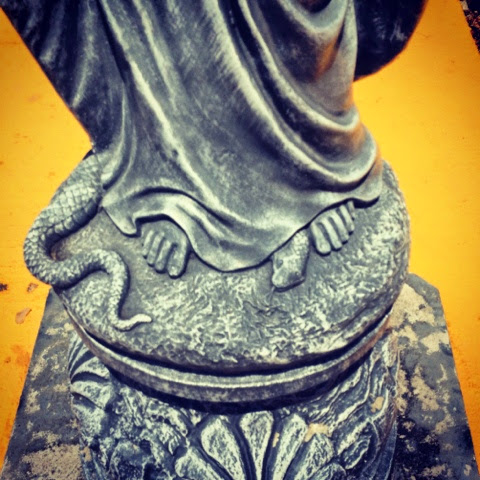
At the Feet of Our Lady of the Best Stop

Tuesday, April 15, 2014
Un goût de cafe pour fumer!
Et des fois le café té assez fort tu pourrais mettre une cullière dans la tasse et la cullière restait debout.
Kaw!!!That's strong!
And sometimes, like ma dad, he'd make a pot of coffee in the morning and là ça rechauffé quand il buvait une 'tite tasse, une 'tite tasse café, demie 'tite tasse, demie tasse, une demie-demie tasse, et là ça c'était juste assez pour fumer, tu connais?
Hahahahahaa!
Un goût de café pour fumer!
Sounds like someone I know!

Monday, April 14, 2014
Bayou des Femmes

A while back my friend Jo Vidrine, who works with the Bayou Vermilion District keeping the bayou clean, tagged a photograph on his Instagram account (@youwillknowwhen) with the tag #bayoudeshommes (Bayou of the Men). The photo was of a bunch of dead red crawfish heads floating in the bayou. I thought the name was an awesome comparison to Prairie des Femmes (Prairie of the Women). Bayou des Hommes recalled for me the work that Jo V and John Oliver literally did in the brown and dark canals of the Bayou Vermilion, but also of the darker, more metaphorical things that we as mankind have done to the bayou.
Check out www.bayoudeshommes.blogspot.com
Recently Jo and I decided to join forces and mix names to create an art show called Bayou des Femmes. It was held April 12, 2014 at Astra Modern Market in downtown Lafayette. We showed photographs of both of our realms, Jo's parents Mr. John and Mrs. Jane Vidrine played music, Reve Coffee Roasters made a special Bayou des Femmes blend and The Loving Cup did a pop-up coffee bar. We had beer, nests, glow in the dark Mary statues, and a lot of fun. It was a great success and I am so glad Jo and I decided to get together and have a show because the themes of our sites worked perfectly together.
Here is the audio of an interview we did with Judith at KRVS about the show:
http://krvs.org/post/apres-midi-april-7-joint-exhibit-astra-modern-market-gallery-art-walk-sat-april-12.
Bayou des Femmes is a collaborative art show of the work of Bayou des Hommes and Prairie des Femmes, blogs run by two young French-speaking Louisianians. Born in juxtaposition out of deep love of place and also as an outlet from the reality of daily life in modern south Louisiana, Bayou des Femmes is an exploration of the timelessness of our homeland, and a reflection of the relationship between nature and culture, prairie and bayou, homme et femme.
 |
| The man, the muse, the parrain: John Oliver poses with his panoramic |
 |
| Prairie des Femmes |
 |
| Gleaux Marie |
 |
| Pouvoir: Homme et Femme! photo cred |
Wednesday, April 9, 2014
 |
| the Apex and the Moon |
When I venture to ask a local elder about the Prairie des Femmes' origins or where I can find an arrowhead, they direct me to this field, which is on a bayou path that I am familiar with.
You can't see it from certain angles, but when you do see it, it is unmistakable; there was a large mound here. The earth swells as a wave, climbing two or three feet gradually, and forming a clear apex out toward the center. It was disorienting to be there. I like being on holy ground. I have passed on idle so many times. I have stopped, too, a handful of times, to photograph the elevation from afar, but I never dared to go out on the field until I happened to correspond online with a local arrowhead hunter, my neighbor up the road. He confirmed again that this was the place, and that indeed there was an old man who walked the field looking at the dirt after they'd plowed and a hard rain had come. He said to just park and go walk. Nobody's gonna mess with you and if they do, just apologize, tell them what you doin. You lookin for an arrowhead. The worst they can do is tell you to get the hell outa there, but... there? Nah. People know what that place is. No one's gonna mess with you.
It's the harvest time. Just last week I passed the field in question and it was knee deep with weeds grown up in the weeks after the harvest. But the fields on this side of the PDF have been getting plowed, so I had the feeling that it had been, also. I waited until the cool of sunset to go out there. I took my boys, sat them down at the treeline with a bag of potato chips and a pig in a blanket each and told them to stay put while I tramped off into the field.
I looked around and around, walking, looking down, listening for trucks that passed, watching the little red and white spots of my children against the black of the treeline, yelling at them occasionally or hearing them playing. I was unprepared for arrowhead hunting in my old red leather loafers, now full of fine dirt, as I had sunk eight inches in places as I walked. At the apex of the mound, which is not extremely pronounced, I took some pictures. I detected a death smell, very faintly, yet clearly. Surely from a field mouse crushed under the plow, I thought, but I could not help to think of the place and wonder what it really was. I picked up clods, but found no stone, no ceramic. I walked crushing the clods in my hands and letting the dust fall. At the high point I found a dark clod of earth, cooler and fresher than that rest, and put it in my pocket.
It seemed to me strange that I was so worshiping this land, an ironic time for me to come there, the permission and the occasion of the harvest coming at the same time that I have been fuming daily about a near neighbor back on my side of the prairie who is excavating a pond and trucking out dozens of Mack trucks a day of Prairie des Femmes dirt to sell, I assume. I hear the grumbling and beeping for twelve hours a day, I can see the machinery. It's officially started to annoy me, not only the noise way back here in the peaceful prairie, but that they were trucking out the land. The Prairie des Femmes, being unceremoniously trucked out, and I had to listen to it all day. Selling earth was taboo to me, I realized, especially this dirt.
I believe it is sacred ground, and it has been desecrated to a point. People have built their own homes on these high places, plowed them repeatedly, dumped and littered them, or else built roads over them, as there are a few roads in the PDF that undulate up over a mound and back down again.
I left as the reds of sunset were fading to oranges and purples. I had found nothing but a dark clod of earth from the apex, but what Frozard had said was true: no one messed with me. Now I needed is a big rain...
 |
| the rise of the plowed mound |
 |
| la terre et mon soulier rouge |
 |
| Sept Aigrettes |
Wednesday, April 2, 2014


Friday, March 28, 2014
Gumbo Tchoc
Mais tu connais quoi c'est un tchoc, hein?
Blackbird, huh?
Blackbird, huh?
Un bon gumbo, ça.
Ho, Jack!
Si ça fait un gumbo!
C'est un gumbo q'arette pas!
The Cardinal Blues
The way the the callers to the Tasse de Cafe Radio program speak French is so beautiful, it's like poetry. The following is transcribed from a conversation I recorded last week of the callers talking about different birds.
Les Blues des Cardinaux
Comment tu dis cardinal en français?
Mais, cardinau!
J'en avais un dans mon cours la semaine passée
j'voulais prendre un portrait.
Monsieur a gone
avant j'peux l'attraper le portrait et l'a'oir
il s'est sauvé!
il té 'près scout around
il va r'venir!
je vas peut-être pas le 'oir
Mais il va r'venir!
un vaillant tite oiseau
c'est joli pour les 'oir
et c'est pas souvent tu les 'oir
Tu les 'ois pas un tas!
Mais c'est joli pour 'oir
j'voulais prendre un portrait.
Monsieur a gone
avant j'peux l'attraper le portrait et l'a'oir
il s'est sauvé!
il té 'près scout around
il va r'venir!
je vas peut-être pas le 'oir
Mais il va r'venir!
un vaillant tite oiseau
c'est joli pour les 'oir
et c'est pas souvent tu les 'oir
Tu les 'ois pas un tas!
Mais c'est joli pour 'oir
Ça aime faire leur 'tite chanson bien tranquil
Ça donne les blues d'attendre ça
Ça donne l'envie danser!
Ça donne les blues d'attendre ça
Ça donne l'envie danser!
!
Tuesday, March 11, 2014


Wednesday, March 5, 2014


Tuesday, February 11, 2014
Une Pierre à Tonerre
Monsieur J.D. Soileau de L'anse Bleu always has something interesting to say. Today he was calling about a story he heard from a local lady about the meteorite that hit Louisiana in 1957. Click here for a piece on it from the Bayou Teche Dispatches.
Il onvait eu beaucoup peur dan 1957 à soir et là il a eu le meteorite qu'a frappé la Louisiane
Oh wow!
Et y a eu... son mari avait gardé dehors, il dit y a quek-chose, force té brillant et y a un clairité
un bout temp après on a attendu gros train... la maison a manière tremblé et ils on eu beaucoup peur et ils ont etait couché chez son père et sa mère.
Et beaucoup de monde avait beucoup peur et y'en a qu'a tombé à genoux.
Et un qui dit...cinq fois plus gros que le soleil et plue clair que la journée.
Comment tu crois?
Et ça frappait à la Côte Blanche là bas au long du côte le la Louisiane... parceque j'ai regardé sus mon computer et y'avait les pecheurs qu'était après pêcher au soir et ça était pleusieurs jours que leurs oreilles faisait manière mal, c'avait fait un gros train!
Comment tu crois!
Et là, y'avait un morceau qu'avait tombé sus un rig.
No kidding, wow!
Et dedans 1957... tu appelles ça une pierre à tonerre (thunder rock)!
une pierre à tonerre!
Ouais, c'est un meteorite...
***********************************************
"Thunder Rock" reminded me of a story I heard from Mr. P. LaHaye recently about the Prairie des Femmes. It seems that years ago he and another researcher were walking around the indian sites in the Prairie and came upon a house at a curve in the road. They asked the woman, who may have been Chat-Tigre's mother, for water. She came out into the front yard and pumped it for them. They thanked her and tried to explain what they were doing by showing her the arrowheads they had found. She immediately motioned to the sky and called them something similar to "thunder rock" and said that they had come from the sky.
***********************************************
A Warning/ Un Advertisement
J.D. went on to say that the old people saw the meteorite as un advertisement, or a warning that something was going to happen. My research says that the meteorite came on March 15, 1957, the Ides of March, and Hurricane Audrey came in late June of the same year.
A Warning/ Un Advertisement
J.D. went on to say that the old people saw the meteorite as un advertisement, or a warning that something was going to happen. My research says that the meteorite came on March 15, 1957, the Ides of March, and Hurricane Audrey came in late June of the same year.
Monday, February 3, 2014


Thursday, January 30, 2014
Friday, January 24, 2014
Quand ils disent c'est p'us pareil,
ça me donne les blues
d'attendre les cardinaux après chanter
Mais quand-même ça chante
Comme dans les années passées
Ca fait danser
D'entendre les cardinaux
après chanter.
Quand ils disent c'est p'us pareil
Le monde parle plus en français
J'attendre les cardinaux après chanter
et le temps après voler
Ashlee Michot, 2014
Thursday, January 23, 2014
Prairie Portraits
Here are a few paintings I have done of the Prairie des Femmes in her different robes.
 |
| Queen of the Borderlands Journal |
 |
| Spirit of Prairie des Femmes |
 |
| Lights on the Prairie |
 |
| The Sunset Towers |
 |
| Prairie des Femmes at Night |
Subscribe to:
Posts
(
Atom
)