Click here for Les Vieux Temps Article UPDATE Oral history is sometimes not entirely accurate. One of the many enjoyments I get from writing articles about old times is the many comments from the readers about different versions of events from the past that they have heard from there elders. Such was the case about the origin of the name Prairie Des Femmes, a community in St. Landry Parish. Apparently the version expressed earlier about the name coming as a result of the Civil War battles was not correct because additional research indicates that the name was in use as early as 1809. Father Hebert’s earliest document in which Prairie Des Femmes was mentioned was a memo written in 1809 from the cattle warden. A document, “Police des Animaux,” which authorizes the picking up of all stray cattle in the District of Grand Coteau, Prairie Des Femmes and Carencro, was signed by George King, parish judge. Prairie Des Femme was mentioned quite frequently by Father Hebert in his research from 1809 to 1830 – years before the Civil War.
David Lanclos has a different explanation:
“I have also heard a version of the story about how the place came to be called by that name. The story goes that as Indian groups traveled through their hunting grounds they often set up camps on the various prairies that bordered Bayou Teche. According to the story, Indians had set up a camp at the place we know today as Prairie Des Femmes. When they decided it was time to move on, there were several women who were too old or too sick to travel. As was often the custom of these Indians, the old women were abandoned at that place, where they were eventually discovered by early settlers who lived in the area. The place thus came to be called Prairie Des Femmes.”
Is this the true story? Who knows, but if we keep exploring it, sooner or later, a definitive version about the origin of the name Prairie Des Femmes is bound to emerge. If anyone has heard a different version, please contact me.
Comments about Les Vieux Temps articles are always appreciated. Please call (337) 754-9980 or e-mail yknott123@aol.com

Friday, August 10, 2012

Thursday, August 9, 2012
Aerials of the Prairie
 |
| Looking south |
 |
| Looking NorthWest |
 |
| The Academy of the Sacred Heart at Grand Coteau |
Tuesday, August 7, 2012
The LaGrange House
The historic Lagrange House is the oldest structure on the prairie. The story I heard about this place is that it was built in the 1700 possibly early 1800s by a former soldier/general in Napoleon's army or his descendant. He was shipwrecked after leaving Egypt picked up with two comrades by a passing ship and left in New Orleans. They were in poor shape when a wealthy planter from les Opelousas recognized their fine French accents and shabby vêtements and knew they were in trouble. He offered to bring them back to his plantation, where, as luck would have it, he had three eligible daughters that each officer married. One of their homesteads was the older house in the photos, most recently inhabited into the 1980's by a family, then an elderly gentleman.


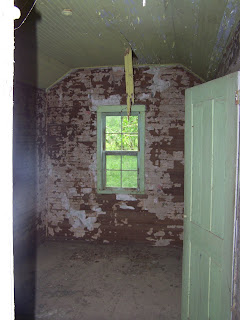 an interior room
 bousillage and pegs in the garconierre


Nonc Dav looking at the LaGrange House, oldest building on the prairie. We were told that the writing on the main wall of the home was done to prevent trespassers.

The cypress foundations.
Wisteria in early March

built-in bed and bousillage wall

the porch and foundations

Decorative rafter ends- Carribean?


John A. Speyrer's Swamp Adventures
Below is an excerpt from John A. Speyrer's web page on the Speyrer Family. "My pirogue was much smaller than the one shown on the left. It was more narrow and shorter. The one-seater pirogue had a tendency to capsize, but I soon learned how to balance the boat. Harnett T. Kane, author of The Bayous of Louisiana mentioned that sometimes only a wink of the eye was all that was needed to disturb the delicate balance of the pirogue! He also mentioned that a heavy dew was sufficient to float the boat! Since I could not bring it to my favorite swamp because it might be stolen, I used it mostly for jaunts down Coulée des Marks in the Prairie des Femmes settlement, transporting it in the trunk of the 1952 Chevrolet my father owned. I'd paddle upstream, lie down in the pirogue and float dreamily down the coulée.
The pirogue was named "L'aigrette" - or in English, The Egret. I even used a stencil to paint a picture on its bow of an egret in flight. The boat was light blue with the word L'aigrette prominently displayed. All of the swamp pictures below are of the shallon boat which was very wide and light. My favorite swamp was where the shallon was kept. It was never stolen, although, no doubt, at times, it was borrowed!. It finally rotted away."


The pirogue was named "L'aigrette" - or in English, The Egret. I even used a stencil to paint a picture on its bow of an egret in flight. The boat was light blue with the word L'aigrette prominently displayed. All of the swamp pictures below are of the shallon boat which was very wide and light. My favorite swamp was where the shallon was kept. It was never stolen, although, no doubt, at times, it was borrowed!. It finally rotted away."
Prairie des Femmes Site of First Land Grant Given by the GovernmentofLouisiana -1776
"The first known land grant by the colonial Louisiana government was in 1776 in the area referred to as Prairie des Femmes.[1] In the early 19th century, Grand Coteau served as a stopping point for travelers between Washington, Louisiana and St. Martinville, Louisiana. The thriving community had two bakeries, a cobbler, millinery, and blacksmith shop, a post office, and an inn where stagecoaches changed horses." Wikipedia

This is interesting to me. A few years back, my aunt KEM started passing along my family's genealogical information to me. In the papers was a copy of a document in Spanish that she said was a special grant given to our ancestor, a Guilbeau and another ancestor, possibly an Arceneaux and a few other Acadian men. It was the first of it's kind in Louisiana. The ranchers were given a herd of cattle from the Spanish Gov. And promised to give herd and a half back in X number of years, I believe, in exchange for the land in the grant. I will continue to research this. I wonder if the land where I have settled was part of the land granted to my ggggggrandfather in the late 1700's?
 The marriage contract of Charles Guilbeau and Madeline Michel in Spanish. St. Martinville, 1788. My Acadian ancestors are called "Juan Guilbeau" and "Pedro Arceneaux" pretty amusing!

This is interesting to me. A few years back, my aunt KEM started passing along my family's genealogical information to me. In the papers was a copy of a document in Spanish that she said was a special grant given to our ancestor, a Guilbeau and another ancestor, possibly an Arceneaux and a few other Acadian men. It was the first of it's kind in Louisiana. The ranchers were given a herd of cattle from the Spanish Gov. And promised to give herd and a half back in X number of years, I believe, in exchange for the land in the grant. I will continue to research this. I wonder if the land where I have settled was part of the land granted to my ggggggrandfather in the late 1700's?

Monday, August 6, 2012
Les Vieux Temps article about PDF
Mr. Floyd Knott's Les Vieux Temps article about la Prairie des Femmes.
"In the mid-1900s, some of the favorite places to dance to Cajun music were the Silver Slipper and the Happy Landing in Pecaniere. It was there, as a youngster, that I met many people from Prairie des Femmes (femmes is French for women). Prairie des Femmes is a community between Grand Coteau, Arnaudville and Opelousas. I was always amazed at the large number of girls from the same family at the dances. One family had eight girls and only one male. Although to a smaller degree, I observed the same pattern with other families. So it was easy to make the assumption that the community was so named because females outnumbered males.
Recently I met Mrs. Marks, an elderly lady from that community. When she introduced herself as coming from Marks Bridge of the Prairie des Femmes area, my curiosity was again aroused. She joked about all the Marks, Quebedeaux, and Lagrange girls in her neighborhood when she was young. So I asked her if she knew the reason why it was so named. I was familiar with the origin of the Marks Bridge name but Prairie des Femmes was only speculation — and indeed when I posed the question she gave me a different explanation from the one I had assumed.
She told me that her grandfather had always told her that during the Civil War most battles were fought along Bayou Teche and Bayou Bourbeau and that before the battles, the menfolk would move the women and children to the safety of the prairie and that was the reason it was called Prairie des Femmes." Floyd Knott

"In the mid-1900s, some of the favorite places to dance to Cajun music were the Silver Slipper and the Happy Landing in Pecaniere. It was there, as a youngster, that I met many people from Prairie des Femmes (femmes is French for women). Prairie des Femmes is a community between Grand Coteau, Arnaudville and Opelousas. I was always amazed at the large number of girls from the same family at the dances. One family had eight girls and only one male. Although to a smaller degree, I observed the same pattern with other families. So it was easy to make the assumption that the community was so named because females outnumbered males.
Recently I met Mrs. Marks, an elderly lady from that community. When she introduced herself as coming from Marks Bridge of the Prairie des Femmes area, my curiosity was again aroused. She joked about all the Marks, Quebedeaux, and Lagrange girls in her neighborhood when she was young. So I asked her if she knew the reason why it was so named. I was familiar with the origin of the Marks Bridge name but Prairie des Femmes was only speculation — and indeed when I posed the question she gave me a different explanation from the one I had assumed.
She told me that her grandfather had always told her that during the Civil War most battles were fought along Bayou Teche and Bayou Bourbeau and that before the battles, the menfolk would move the women and children to the safety of the prairie and that was the reason it was called Prairie des Femmes." Floyd Knott
Les Bons Jours Hurricane Tracking Chart
Good Days: Tracking Hurricanes with the Lafayette Council on Aging

Various Landscapes of the Prairie
Thomassee Road in the summer  Les jambes de pluie toward Grand Coteau
 a purple field on Jules LaGrange road
  arc en ciel to the east
  the ho,stead under a late summer sky
Sunday, August 5, 2012


Ceramic shards in the Field
We like to walk the perimeter of our eight acre property in the evenings. Sometimes, usually after a good rain, we'll go to the row of young live oaks or the parish ditch on the east of the property where there is a concentration of glass and pottery shards. We find what seem to be old ceramic or stoneware pots, crocks, and cups and plates made of milk glass. We usually find white, in all shapes. They come with beautiful angles, all a little different with no exact matches in quality or shape. Sometimes we find blue designs on them, old and new, or a piece of what seem to be the decorative curl of a fleur de lis. Sometimes there are chunks of thick pottery white on one side, black on the other and made of fine cement-like material. This area in general has been inhabited by French Creole settlers since well before 1800, and before that the Opelousa Indians rested here when hunting in the oxbow swamp. When we moved here, it had been a sweet potato field and let to go fallow for years. So how old are these shards? Were they left from trash dumps behind houses? Brought by flood? Used by farmers to aerate the field? Why are they all different, yet concentrated in one area? Were there houses all the way back here in our field, long ago? For now we'll keep filling mason jars with them as we try to piece together the jigsaw of PDF history they have revealed to us.


The Mysterious PDF by K. Cornell
Here is a link to a set of images taken back in 2006 seen through the beautiful eye of our friend kccornell. Velvet live oaks in winter at the fringes of the oxbow, the old LaGrange house made of cypress pegs and bousillage, the garçonière, red brick hearth, newspaper wallpaper, original cypress pylons. Really beautiful set. Thanks, K. Cornell!!
photo credits K. Cornell
 |
 |
La Prairie des Femmes

La Prairie des Femmes (Women's Prairie) is a pre-colonial prairie name, located in Saint Landry Parish, Louisiana that borders an oxbow-shaped swamp to the north, Bayou Bourbeau to the west, and Pointe Claire to the east. Prairie Laurent is to the north/northwest and la Prairie Basse to the south. The nearest town is Leonville, and the towns of Arnaudville (La Jonction) and historic Grand Coteau are nearby. Coulée des Marks runs through la Prairie des Femmes and creates a cypress basin at the country intersection of Thomassee and Jules Lagrange roads at Pont des Marks, or Mark's Bridge.
Prairie des Femmes appears on detailed maps of the region as early as 1806, having been inhabited by French Creoles well before this time. The prairie was at the border of the Atakapas and Opelousa tribe's territories, so there was much Indian traffic through the area. Legend has that the area was a high land, a safe zone near the bayous where Native American women lived together while the men hunted or warred with neighboring tribes. Another story says that in Louisiana's historic flood of 1927 that woman and children were sent there from neighboring communities because of its safety. Another tale sites the area as a place where the widows of the soldiers of the Civil War settled to live the remainder of their lives in peace. The most likely story of the origin of the name Prairie des Femmes has two versions: One is that the natives inhabiting the prairie moved after a hunt, as was custom. A few of their old women were left at the camp being too old to move. The other version is similar, but is more mysterious: that the braves went off one day on a hunt leaving the women and children and simply never came back. The women left there were discovered by the French Creoles and Acadians who settled the area who called it La Prairie des Femmes.

Subscribe to:
Posts
(
Atom
)